

Why Your Business Feels Slow: Understanding the Pre-Success Phase in Entrepreneurship

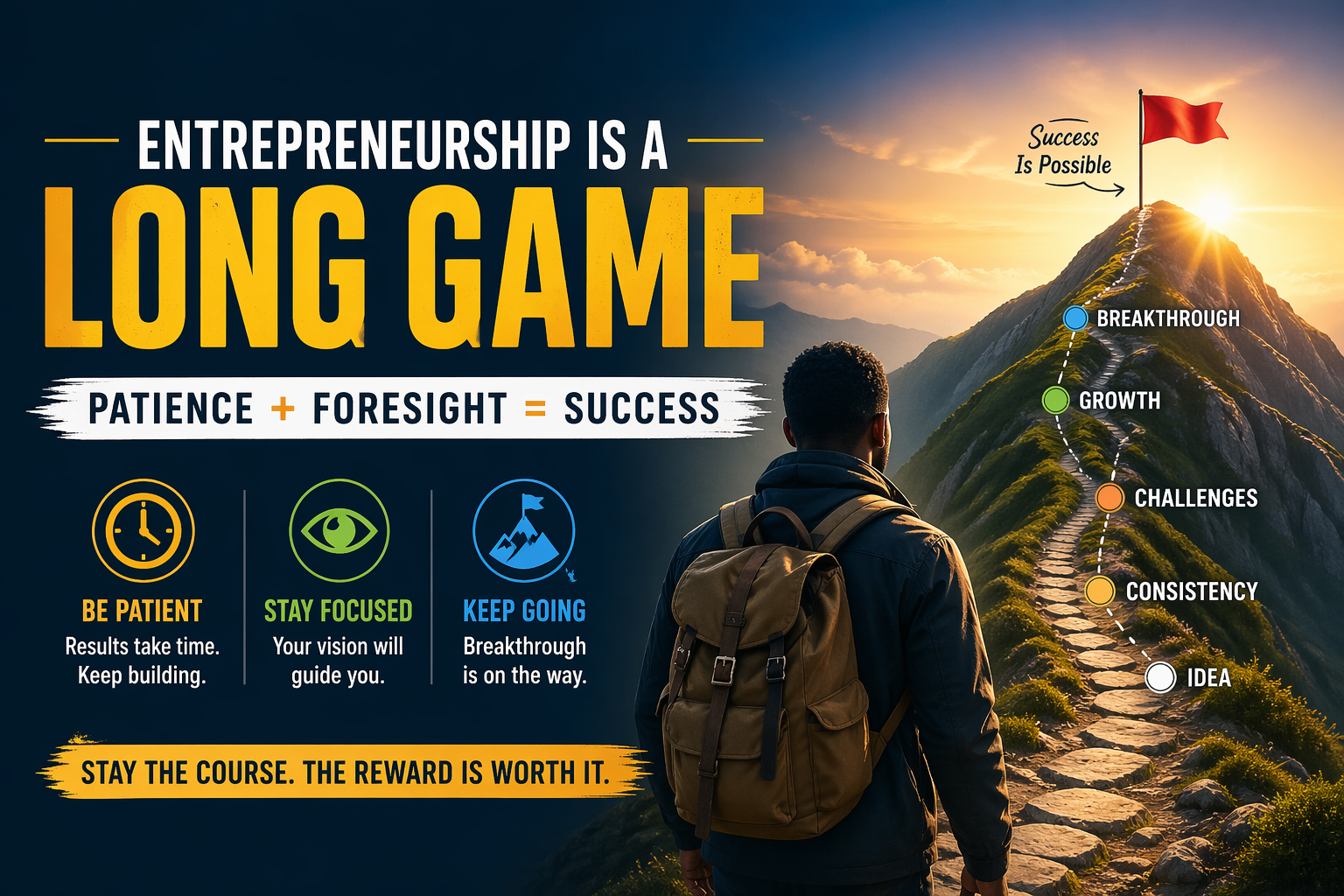
Entrepreneurship is often glamorized as a fast path to success, wealth, and freedom. But in reality, it is a long, demanding journey—one that requires foresight, patience, and sustained endurance.
For anyone building a business, understanding this truth is not optional—it is foundational.
The Reality of Entrepreneurship: It’s a Long Game
At its core, entrepreneurship is not about quick wins. It is about long-term value creation.
Many aspiring entrepreneurs enter the business world with high expectations of rapid growth. However, the reality is far more complex. Building a sustainable business takes time, consistent effort, and the ability to navigate uncertainty.
Those who succeed are not necessarily the most talented or the most resourced. More often, they are the ones who stay committed long enough to see results.
The True Nature of Patience in Business
Patience in entrepreneurship goes beyond simply “waiting.”
It is:
- The ability to keep working without immediate results
- The discipline to stay consistent despite slow progress
- The resilience to continue when outcomes are uncertain
In many cases, this level of patience can feel excessive—or even irrational. There are moments when continuing to invest time, energy, and resources into a business without visible returns may seem unwise.
Yet, this is exactly what the entrepreneurial journey demands.
When There Is No Evidence of Success
One of the most challenging phases in entrepreneurship is the “invisible progress” stage.
This is the period where:
- Efforts do not translate into immediate results
- Growth is not visible
- External validation is minimal or nonexistent
During this stage, many entrepreneurs quit—not because the business lacks potential, but because the results are not yet visible.
Successful entrepreneurs, however, rely on foresight during these moments. They continue building based on a clear vision of what the future can become, rather than what is currently visible.
Why Foresight Is a Strategic Advantage
Foresight is the ability to anticipate and prepare for future opportunities.
In entrepreneurship, it allows you to:
- Make decisions based on long-term outcomes rather than short-term comfort
- Stay committed during uncertain phases
- Position your business ahead of emerging trends
Foresight is what keeps an entrepreneur grounded when results are delayed. It acts as a mental framework that sustains belief and direction.
Not All Businesses Are Built the Same
It is important to recognize that entrepreneurial experiences vary widely.
Some businesses are relatively easier to start and scale, especially those with:
- Low capital requirements
- Immediate market demand
- Simple operational structures
However, other industries are significantly more complex and demanding.
Industries That Require Extreme Patience
- Technology and software development
- Automation and AI-driven solutions
- Fintech and financial services
- Certain areas of agribusiness
These sectors often involve:
- Long development cycles
- Regulatory challenges
- High capital investment
- Delayed profitability
Entrepreneurs in these spaces must operate with an even greater level of patience and foresight.
The Cost of Impatience in Entrepreneurship
Impatience can be one of the most expensive mistakes in business.
It often leads to:
- Abandoning viable ideas too early
- Constantly switching strategies without giving them time to work
- Emotional decision-making instead of strategic thinking
In contrast, patience allows strategies to mature, systems to stabilize, and results to compound over time.
Real Examples: Businesses That Prove Patience Pays
To fully understand the role of patience and foresight in entrepreneurship, it helps to examine real companies—both Nigerian and global—that endured long, uncertain phases before reaching stability or profitability.
These examples reinforce a critical truth: success in business is often delayed, but rarely denied for those who persist strategically.
Flutterwave
- Founded: 2016
- Profitability / PLP Estimate: ~4–6 years (scaling phase still ongoing)
Flutterwave entered a highly regulated and complex fintech space. For years, the company focused on infrastructure, partnerships, and compliance rather than immediate profits. Its growth trajectory reflects deep foresight—prioritizing ecosystem dominance over short-term gains.
Paystack
- Founded: 2015
- Profitability / PLP Estimate: ~5 years (acquired in 2020)
Paystack spent its early years refining its product and building trust in Nigeria’s digital payment space. Its acquisition by Stripe in 2020 was not an overnight success—it was the result of years of consistent execution and patience.
Interswitch
- Founded: 2002
- Profitability / PLP Estimate: ~7–10 years
Interswitch is a classic example of long-term endurance. Operating in a then-underdeveloped digital payments ecosystem, the company had to build both infrastructure and market trust from scratch—an effort that took nearly a decade to fully stabilize.
Amazon
- Founded: 1994
- Profitability: ~9 years (first annual profit in 2003)
Amazon is one of the most cited examples of extreme patience in business. For nearly a decade, the company operated without profit, reinvesting heavily into growth, logistics, and technology. Today, it stands as a global giant—validating long-term strategic thinking.
Tesla
- Founded: 2003
- Profitability: ~17 years (first full-year profit in 2020)
Tesla’s journey was marked by skepticism, production challenges, and financial instability. Yet, under the leadership of Elon Musk, the company maintained a long-term vision that eventually paid off.
- Founded: 2004
- Profitability: ~5 years (became profitable in 2009)
Now known as Meta Platforms, Facebook focused heavily on user growth before monetization. This strategic patience allowed it to dominate the social media space globally.
Airbnb
- Founded: 2008
- Profitability: ~12 years (first profitable year in 2020)
Airbnb faced multiple rejections from investors in its early years. The founders relied on creative survival strategies while refining their model. Their eventual success highlights the importance of endurance through uncertain phases.
Key Insight from These Examples
Across both Nigerian and global contexts, a clear pattern emerges:
- Complex industries require longer patience cycles
- Early years are often focused on building, not earning
- Profitability is usually delayed—but strategic positioning is happening in the background
This aligns directly with the Project Life-Point (PLP) concept:
The stage where accumulated effort, time, and resources begin to produce visible and sustainable returns.
How to Build Patience as an Entrepreneur
Patience is not just a personality trait—it is a skill that can be developed.
Here are practical ways to strengthen it:
1. Focus on Process Over Results
Shift your attention from immediate outcomes to daily execution.
2. Set Long-Term Milestones
Break your vision into achievable phases to maintain motivation.
3. Track Progress Internally
Not all progress is visible externally. Measure growth in systems, skills, and structure.
4. Understand Your Industry Timeline
Different industries have different growth cycles. Align your expectations accordingly.
5. Build Mental Resilience
Entrepreneurship requires emotional strength. Develop the capacity to stay steady under pressure.
Final Takeaway
If your business is taking longer than expected to yield results, it does not automatically indicate failure.
It may simply mean:
- You are operating in a high-complexity industry
- You are still within your pre-PLP phase
- Your investments have not yet matured into visible outcomes
The key is to remain strategic—not just patient.
Conclusion: Patience Is Not Optional
Entrepreneurship is not designed for instant gratification. It is a process that tests commitment, vision, and endurance.
Patience, combined with foresight, is what sustains entrepreneurs through uncertainty and positions them for long-term success.
The journey may feel slow. It may feel uncertain. At times, it may even feel unreasonable.
But in the end, those who understand the long game—and are willing to stay in it—are the ones who build lasting impact.
Over to You
Before you go, take a moment to engage.
What stood out to you most in this post? Let me know in the comments.