

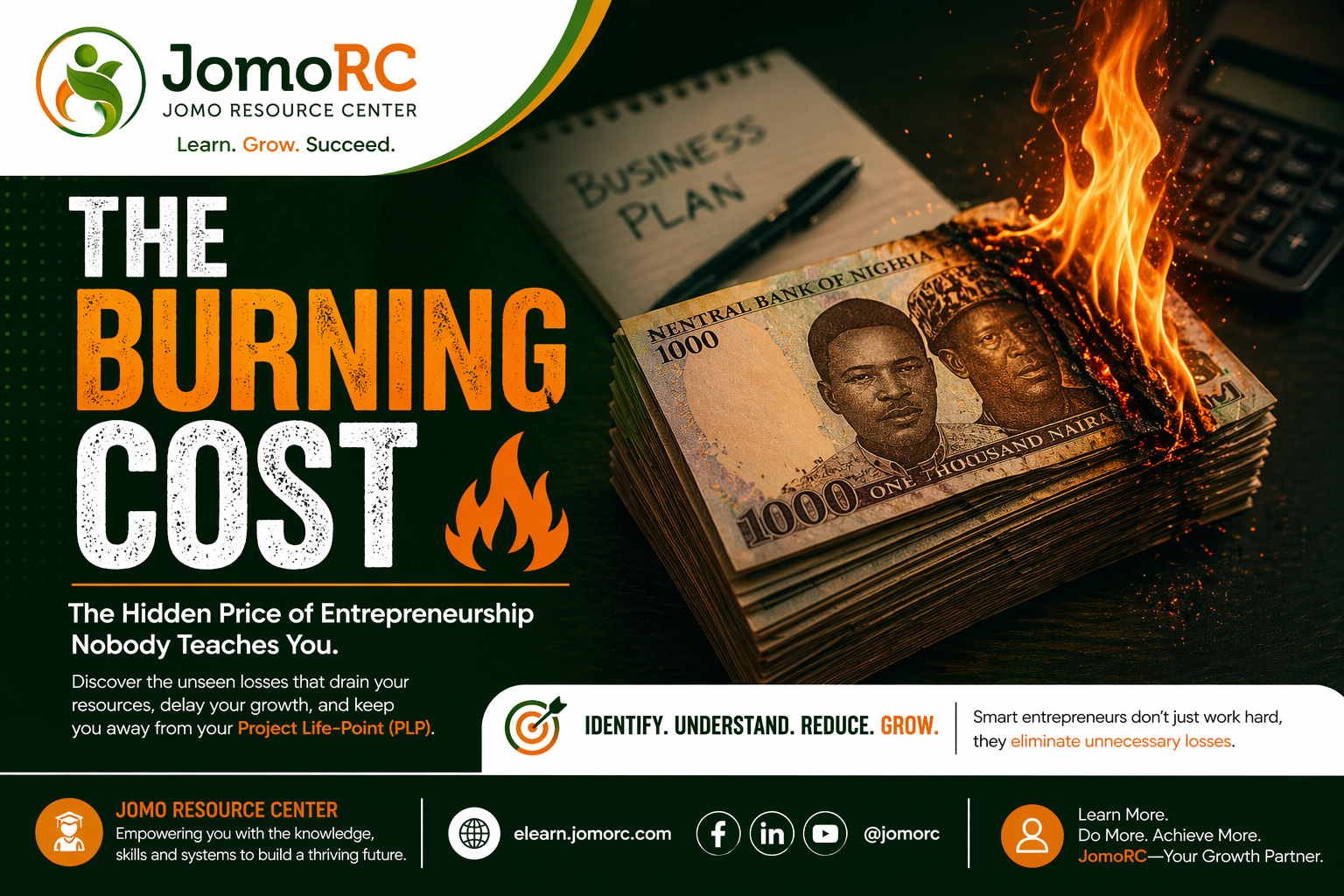
The Burning Cost: The Hidden Price of Entrepreneurship Nobody Teaches You

Every entrepreneur prepares for startup capital, operational expenses, and even unforeseen risks. But there is a category of cost that quietly drains resources without warning or structure.
It is not captured in your business plan.
It is not taught in classrooms.
It is rarely discussed openly.
I call it The Burning Cost—the money you spend without getting value in return.
This cost is one of the biggest reasons many businesses struggle, stall, or take far longer than expected to reach their breakthrough stage—what I describe as the Project Life-Point (PLP), where results begin to compound.
What Is the Burning Cost?
Burning Cost is the financial loss incurred when you pay for a service, decision, or system that fails to deliver its intended value.
It is not an investment.
It is not productive spending.
It is avoidable leakage—if properly understood.
My Experience with Burning Cost
When I left my job in mid 2022 to build Jomo Resource Center, I understood one thing clearly:
Because of the nature of the training industry and limited leverage at the early stage, my Project Life-Point (PLP)—the stage where results begin to compound—would take time.
So I decided to create a support system: a small computer service shop offering typing, printing, and photocopying services.
It looked like a simple, logical move.
It wasn’t.
1. The First Loss: Paying for What You Didn’t Understand
I approached the commercial committee at the University of Calabar and paid ₦80,000 for a shop space.
What I got instead was empty land.
No structure. No setup. Nothing.
I didn’t have the capital to build from scratch. That ₦80,000 was gone. All efforts to get a refund was unfruitful, after a long struggle, i gave up.
Burning Cost #1: Lack of due diligence.
2. The Second Loss: Information Asymmetry
Next, I found someone leaving an already built shop. He had 10 months of rent left and wanted compensation.
I paid him.
Later, I discovered I had paid over ₦20,000 more than what he originally paid.
Burning Cost #2: Paying for information you didn’t have.
3. The Third Loss: Market Reality
After setting up, reality hit:
- Low patronage
- Poor foot traffic
- Unstable electricity
The business wasn’t just slow—it was unsustainable.
I shut it down.
Burning Cost #3: Misjudging market viability.
4. The Fourth Loss: System Failure (CAC Registration)
When registering Jomo Resource Center as a limited liability company, I attempted to handle it myself.
Everything went fine—until I needed to correct a submission.
The portal stopped responding.
I hired:
- One freelancer
- Then another
- Then another
All failed.
Eventually, I spent over three times the original cost, only to settle for registering as a business name instead.
Years later, trying again to upgrade to a limited liability company, I encountered the same cycle:
- Payments made
- No results
- Blame shifted to the system
Burning Cost #4: System inefficiency + repeated failed outsourcing.
5. The Fifth Loss: Trusting the Wrong People
From branding to advertising campaigns, I lost money to:
- Incompetent freelancers
- Poor execution
- Outright fraud
These weren’t just financial losses—they delayed the growth of the business.
Burning Cost #5: Trust misallocation.
Why the Burning Cost Is So Dangerous
The danger is not just the money lost.
It’s what that money represents:
1. Lost Time
Every failed hire or wrong decision delays momentum.
2. Lost Opportunities
Capital tied up in mistakes cannot be deployed into growth.
3. Emotional Drain
Repeated losses reduce confidence and decision-making clarity.
4. Delayed PLP (Project Life-Point)
The more burning costs you accumulate, the longer it takes to reach the stage where your business begins to compound.
Why No One Teaches This
Traditional business education focuses on:
- Strategy
- Finance
- Marketing
- Operations
But it assumes:
- Efficient systems
- Reliable service providers
- Predictable environments
In reality—especially in markets like Nigeria:
- Systems fail
- People underdeliver
- Information is uneven
- Trust is expensive
The Burning Cost lives in this gap between theory and reality.
Types of Burning Cost Every Entrepreneur Must Recognize
1. Decision-Based Burning Cost
This occurs when strategic choices are made based on assumptions rather than validated realities. Many business ideas appear logical but fail due to context—wrong location, wrong timing, or wrong market conditions. These decisions often feel right in theory but collapse in execution. The danger lies in how quickly they consume capital while giving false signals of progress. Without proper validation, entrepreneurs commit resources to ideas that were never viable. The key issue is not effort, but direction.
2. People-Based Burning Cost
This arises from hiring individuals who lack the competence or alignment required to deliver results. Many entrepreneurs choose service providers based on affordability or urgency, rather than proven capability. The result is repeated spending on the same task, delays, and substandard outcomes. In some cases, the entrepreneur does not even know what quality should look like, making it easier to be misled. Over time, this erodes both financial resources and execution speed. The real cost is not just money—but lost momentum.
3. System-Based Burning Cost
This is driven by inefficiencies in external systems such as government processes, infrastructure, or digital platforms. Delays, downtime, and bureaucratic bottlenecks create repeated expenses and disrupt planning. Entrepreneurs often find themselves paying multiple times simply because systems fail to function as expected. While this type of cost is largely outside your control, its impact is very real. It forces businesses into reactive decision-making and extended timelines. Operating without accounting for system friction is a costly oversight.
4. Information-Based Burning Cost
This occurs when decisions are made without complete or accurate information. Entrepreneurs may overpay, enter unfavorable agreements, or misjudge opportunities simply because they lack the necessary insight. These losses are often subtle and go unnoticed, making them particularly dangerous. Without proper benchmarking or industry knowledge, poor decisions become normalized. Information gaps create invisible inefficiencies that quietly drain resources. In many cases, what you don’t know becomes what you pay for.
5. Fraud-Based Burning Cost
This is the result of intentional deception—paying for services that are never delivered or engaging with individuals who misrepresent their capabilities. It often exploits urgency, trust, or inexperience. Unlike other forms of burning cost, this category usually results in total financial loss with little chance of recovery. Beyond money, it damages confidence and trust in future engagements. Fraud thrives in environments where verification is weak and decisions are rushed. It is one of the most painful—but preventable—forms of loss.
How to Reduce Burning Cost (Practical Strategies)
1. Pay for Competence Early
Trying to minimize cost by hiring the cheapest option often leads to higher expenses in the long run. Competent professionals bring clarity, experience, and execution precision that reduce errors and eliminate the need for repeated work. While their fees may appear higher initially, they deliver value more efficiently and reliably. This shortens timelines and preserves business momentum. Paying for competence is not an expense—it is a strategic investment in accuracy. In most cases, quality paid once is cheaper than mediocrity paid for repeatedly.
2. Validate Before You Commit
Many losses occur because ideas are executed before they are tested. Validation allows you to assess viability with minimal financial exposure. By testing concepts on a smaller scale, you gain real-world feedback that reveals flaws early. This reduces uncertainty and prevents large-scale mistakes. Validation shifts decision-making from assumption to evidence. It ensures that when you commit resources, you are building on proven demand rather than speculation. A small test today can prevent a large loss tomorrow.
3. Build Information Networks
Access to the right information can significantly reduce costly mistakes. Engaging with mentors, peers, and industry insiders provides insights that are not publicly available. These networks help you understand pricing standards, avoid unreliable service providers, and identify hidden risks. Learning from others’ experiences is far cheaper than learning solely from your own mistakes. Strong information networks improve both decision quality and execution speed. In business, who you talk to often determines what you avoid.
4. Document and Verify Everything
Clarity is a financial protection tool. Every agreement, expectation, and scope of work should be properly documented before any payment is made. Verification ensures alignment between what is promised and what will be delivered. This reduces ambiguity and creates accountability for all parties involved. It also provides a reference point in case of disputes or underperformance. Many burning costs arise from informal or assumed agreements. Proper documentation transforms uncertainty into structure.
5. Start Lean, Then Expand
Heavy upfront investment increases the risk of significant losses if things go wrong. A lean approach allows you to test ideas with minimal resources while maintaining flexibility. Starting small makes it easier to adjust, pivot, or even exit without major damage. As demand becomes clearer, you can scale with greater confidence. This approach reduces exposure to uncertainty and preserves capital for growth opportunities. Sustainable expansion should be driven by validation, not assumption.
6. Separate Trust from Emotion
Emotional decisions are a major driver of financial loss in business. Trust should be based on verifiable evidence, not persuasion or urgency. Many service providers appear convincing but lack the capability to deliver. By focusing on track records, references, and proven results, you reduce the risk of poor decisions. This approach protects you from manipulation and misjudgment. Rational evaluation should always take precedence over emotional comfort. In business, trust must be earned—not assumed.
7. Expect System Friction
Operating in imperfect environments requires realistic expectations. Delays, inefficiencies, and disruptions are common and should be factored into planning. By building time and financial buffers, you reduce the pressure to make rushed decisions when systems fail. This preparedness allows you to navigate challenges without incurring additional losses. Expecting friction does not mean accepting inefficiency—it means planning intelligently around it. Strategic patience is often more cost-effective than reactive urgency.
Turning Burning Cost into Learning Cost
Burning cost is not entirely avoidable—but it is manageable.
The most successful entrepreneurs are not those who avoid mistakes completely, but those who:
- Recognize patterns early
- Learn quickly
- Adjust decisively
When properly managed, burning cost evolves into learning cost—a necessary investment in experience and growth.
Over to You
If you found this helpful, don’t leave without sharing your thoughts.
What’s one key lesson you’re taking away from this post? Drop it in the comments below.