

The 10 Reasons Why Job Applications Fail: The Employer’s Perspective

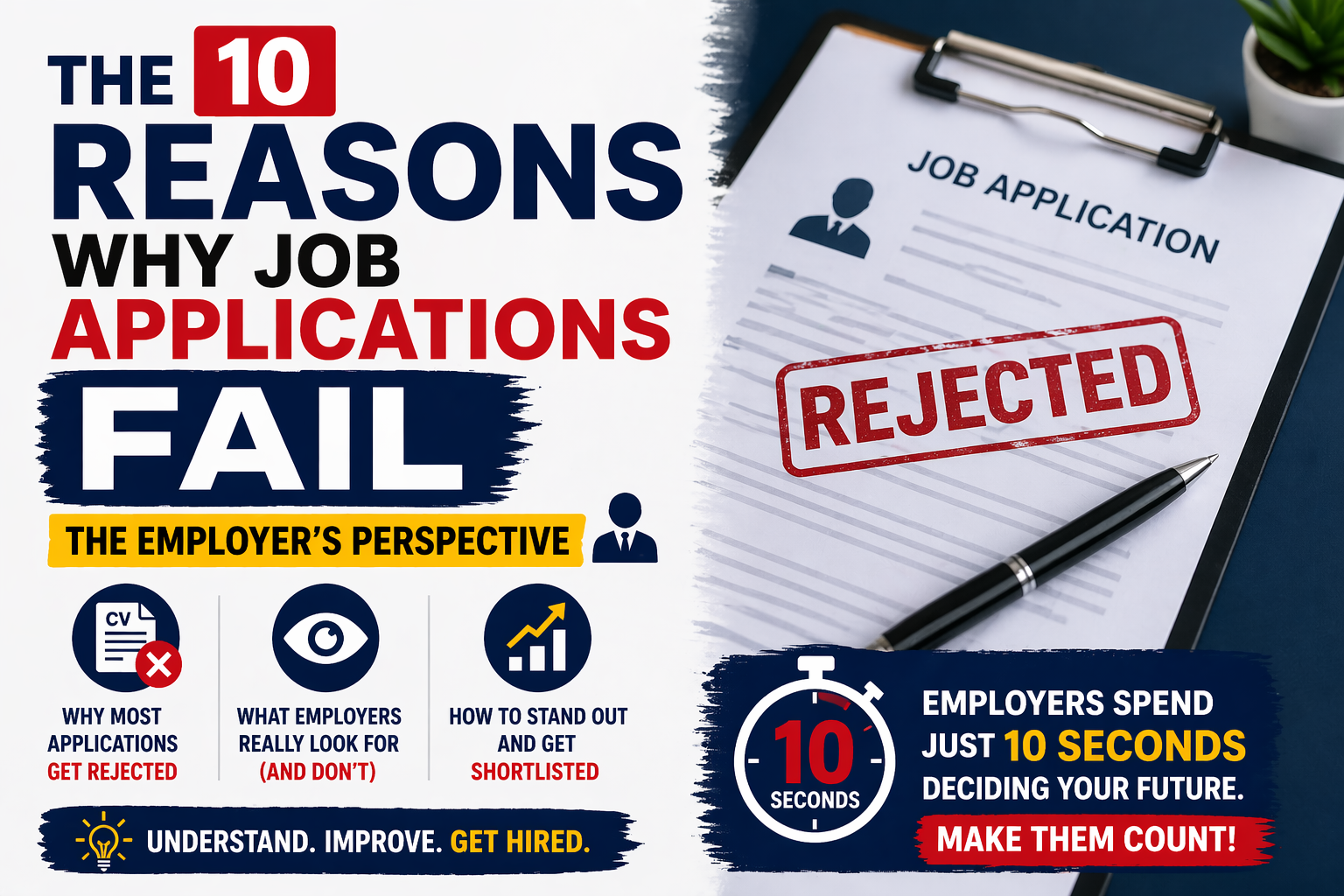
Many qualified candidates submit countless applications but receive little or no response.
From the job seeker’s perspective, it can feel frustrating and unfair.
But from the employer’s perspective, the story is often very different.
Employers are not rejecting candidates randomly—they are filtering for relevance, clarity, and value.
If you understand why job applications fail, you can significantly improve your chances of getting shortlisted.
In this article, we break down the 10 most common reasons job applications fail, based on how employers actually evaluate candidates.
Why Understanding the Employer’s Perspective Matters
Employers are not just filling roles—they are solving problems.
Every job opening exists because:
- There is a gap in the organization
- There is work that needs to be done
- There is a result the company wants to achieve
So when employers review applications, they are asking one key question:
“Can this person solve our problem?”
If your application does not clearly answer that, it will likely fail.
1. Lack of Role Relevance
One of the fastest ways to get rejected is submitting a generic application.
Employers quickly scan for:
- Relevant experience
- Related skills
- Industry alignment
If your application does not match the role, it is often discarded within seconds.
Employer’s Thought Process:
“This candidate does not fit what we are looking for.”
2. Poorly Written CV
A poorly structured CV creates immediate doubt.
Common issues include:
- Cluttered layout
- Long, unreadable paragraphs
- Inconsistent formatting
- Missing key information
Employers do not have time to “figure out” your CV.
If it is not clear, it is ignored.
3. No Clear Value Proposition
Many applications fail because they do not answer:
“What value does this candidate bring?”
Listing qualifications is not enough.
Employers want to see:
- What you can do
- What you have achieved
- How you can contribute
If your application lacks clarity, it loses impact.
4. Focusing on Responsibilities Instead of Results
This is one of the most common mistakes.
Weak:
“Responsible for managing sales operations”
Strong:
“Increased sales revenue by 25% within 6 months”
Employers are interested in:
- Impact
- Results
- Outcomes
Not just duties.
5. Lack of Relevant Skills
Even if you have a degree, employers prioritize skills that can be applied immediately.
Examples include:
- Digital skills
- Analytical skills
- Communication skills
- Technical competencies
If your application does not show relevant skills, it signals low readiness.
6. Failure to Customize the Application
Sending the same CV to multiple employers is a major mistake.
Employers can quickly detect:
- Generic CVs
- Untailored cover letters
- Lack of effort
Employer’s Thought Process:
“If this candidate didn’t take time to understand our needs, why should we consider them?”
7. Weak or No Cover Letter
A missing or poorly written cover letter reduces your chances.
A strong cover letter should:
- Show understanding of the role
- Highlight relevant experience
- Communicate enthusiasm
- Position you as a solution
Without this, your application may feel incomplete.
8. Lack of Experience or Practical Exposure
Employers often prefer candidates who have:
- Internships
- Projects
- Volunteer experience
- Freelance work
Even for entry-level roles, they want evidence of real-world exposure.
Important:
Experience is not only about jobs—it is about what you have done.
9. Poor Professional Presentation
Small details can ruin an application:
- Spelling errors
- Poor grammar
- Unprofessional email addresses
- Inconsistent formatting
These issues signal:
- Carelessness
- Lack of attention to detail
- Poor communication skills
And employers take that seriously.
10. Weak Personal Branding and Visibility
In today’s job market, employers often go beyond your CV.
They may check:
- LinkedIn profile
- Online presence
- Portfolio (if applicable)
If you have:
- No professional presence
- No visible proof of your skills
You may lose credibility.
The Hidden Reality of Job Applications
Many job seekers assume:
“If I am qualified, I should be selected.”
But the reality is:
Employers don’t select the most qualified—they select the most relevant and well-presented.
Your application must:
- Capture attention quickly
- Communicate value clearly
- Align with the employer’s needs
How to Improve Your Job Applications
To increase your chances of success:
- Tailor every CV to the job role
- Focus on achievements, not duties
- Highlight relevant skills clearly
- Maintain a clean, professional format
- Build experience through projects and internships
- Strengthen your personal brand
Final Thought
Job application failure is not always about a lack of opportunity.
Often, it is about a gap in positioning and presentation.
When you start thinking like an employer, you begin to:
- Communicate better
- Present yourself more effectively
- Stand out in a crowded market
And that is what turns applications into opportunities.
Over to You
Found this inspiring? I’d love to hear from you.
What’s one thing you learned from this post? Share it in the comments below.