

What Employers Actually Look for in 10 Seconds of Reading a CV

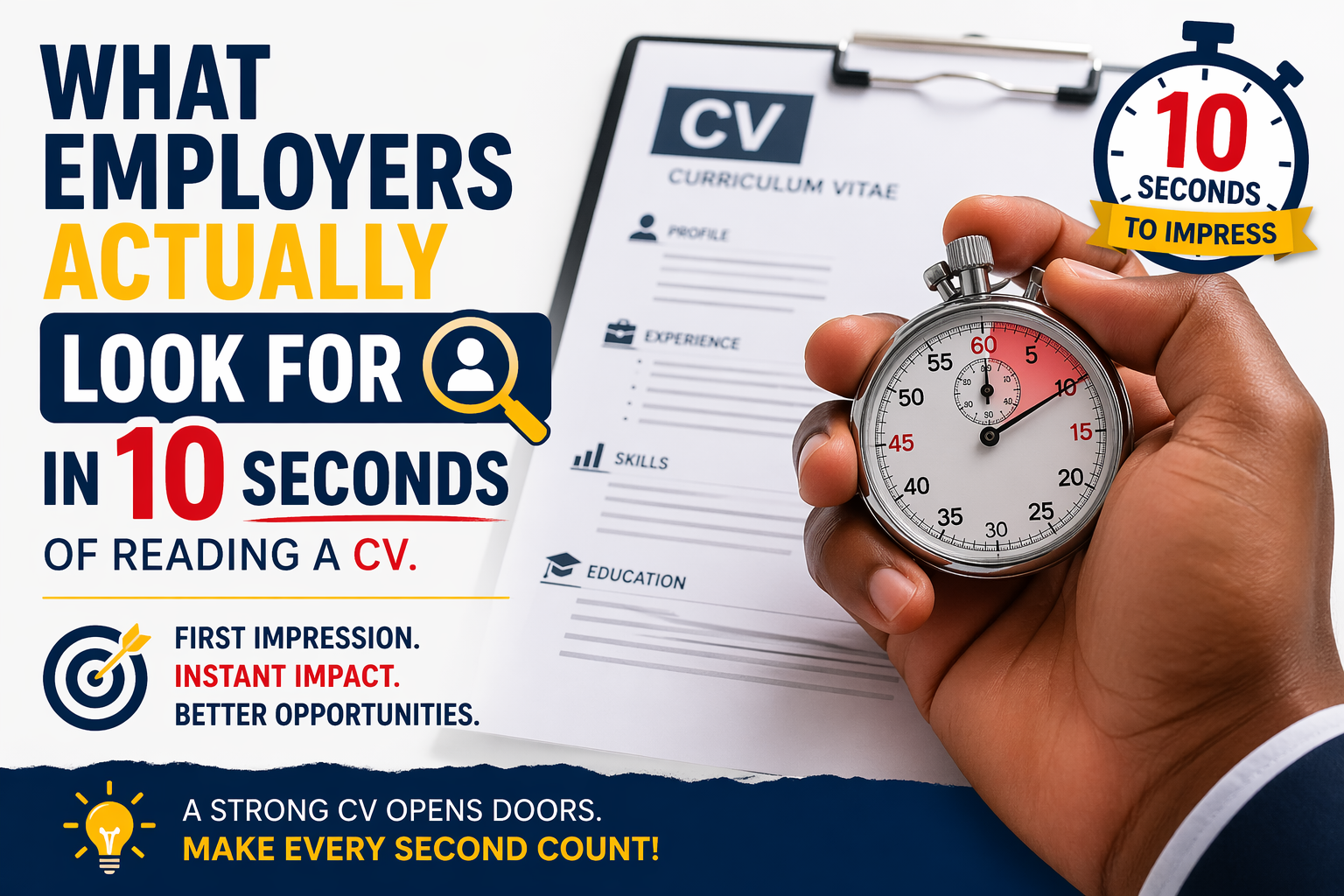
In today’s highly competitive job market, your CV is not just a document—it is your first and most critical opportunity to make an impression.
The harsh reality?
Most employers spend between 6 to 10 seconds scanning a CV before deciding whether to continue reading or move on.
This means that within those few seconds, your CV must answer one key question:
“Is this candidate worth my time?”
If your CV fails to communicate value instantly, it gets rejected—regardless of your qualifications.
In this article, we break down exactly what employers look for in the first 10 seconds of reading a CV, and how you can position yourself to stand out.
Why the First 10 Seconds Matter
Recruiters often review hundreds of CVs for a single role. Due to time constraints, they don’t read every CV in detail—they scan.
During this scan, they are looking for signals of relevance, competence, and clarity.
If they don’t find these signals quickly, they move on.
Key Insight:
Your CV is not read first—it is judged first.
1. Clear Professional Identity
The first thing employers look for is:
Who are you professionally?
Within seconds, they want to understand:
- Your field or career path
- Your level of experience
- Your area of specialization
Weak Example:
“Graduate of Business Administration”
Strong Example:
“Entry-Level Data Analyst with skills in Excel, SQL, and Data Visualization”
Why It Matters
A clear identity helps the recruiter immediately place you within a role.
If your CV is vague, it creates confusion—and confusion leads to rejection.
2. Relevance to the Job Role
Employers quickly check:
“Does this CV match what we are looking for?”
They scan for:
- Relevant skills
- Related experience
- Industry alignment
If your CV looks generic or unrelated, it is often ignored.
Key Tip:
Always tailor your CV to match the specific job description.
3. Evidence of Value (Achievements, Not Just Duties)
One of the biggest mistakes job seekers make is listing responsibilities instead of results.
Employers are not impressed by what you were assigned to do.
They care about what you actually achieved.
Weak Statement:
“Responsible for managing social media accounts”
Strong Statement:
“Grew Instagram engagement by 40% in 3 months through targeted content strategy”
What Employers Look For:
- Measurable results
- Impact
- Contributions
Rule:
If it cannot show value, it adds little impact.
4. Key Skills at a Glance
Recruiters scan for keywords.
These may include:
- Technical skills (e.g., Excel, Python, SEO)
- Soft skills (e.g., communication, leadership)
- Industry-specific tools
Many companies also use Applicant Tracking Systems (ATS) to filter CVs.
If your CV lacks relevant keywords, it may not even reach a human recruiter.
5. Clean and Professional Structure
Presentation matters more than most people realize.
Within seconds, employers assess:
- Layout
- Readability
- Organization
A cluttered or poorly formatted CV sends a negative signal.
What Works:
- Clear headings
- Bullet points
- Consistent formatting
- Logical flow
What Fails:
- Long paragraphs
- Disorganized sections
- Too many fonts or styles
6. Experience Level and Career Progression
Employers quickly evaluate:
- How much experience you have
- Whether your experience is relevant
- Your career growth over time
Even if you are entry-level, they still look for:
- Internships
- Projects
- Volunteer experience
- Freelance work
Important:
No experience does not mean no value—but you must show evidence of exposure and effort.
7. Signs of Seriousness and Professionalism
Subtle cues matter.
Employers unconsciously assess:
- Language quality
- Grammar and spelling
- Email address professionalism
- Consistency in formatting
Errors in your CV suggest:
- Lack of attention to detail
- Poor communication skills
- Low professionalism
8. Alignment with Business Needs
Ultimately, employers are asking:
“Can this person solve our problem?”
They are not hiring you because:
- You need a job
- You have a degree
They are hiring you because:
- They have a need
- You can meet that need
Your CV must clearly show:
- What you can do
- How you can help
- Why you are relevant
The Reality Most Job Seekers Ignore
Many job seekers believe:
“If I am qualified, I will be selected.”
But the truth is:
If you cannot communicate your value quickly, you will be ignored.
Your CV is not just a record of your past.
It is a marketing document designed to sell your professional value.
How to Win the First 10 Seconds
To stand out instantly, your CV must:
- Start with a clear professional identity
- Be tailored to the job role
- Highlight measurable achievements
- Showcase relevant skills
- Maintain a clean, structured layout
- Communicate value quickly and clearly
Final Thought
In the Nigerian job market—and even globally—opportunities are not always given to the most qualified candidates.
They are given to those who can present their value clearly and convincingly.
Your CV is your first chance to do that.
Make it count.
Over to You
Before you go, take a moment to engage.
What stood out to you most in this post? Let me know in the comments.