

What is Business? A Practical Framework for Building Value-Driven and Scalable Enterprises

What is Business, Really?
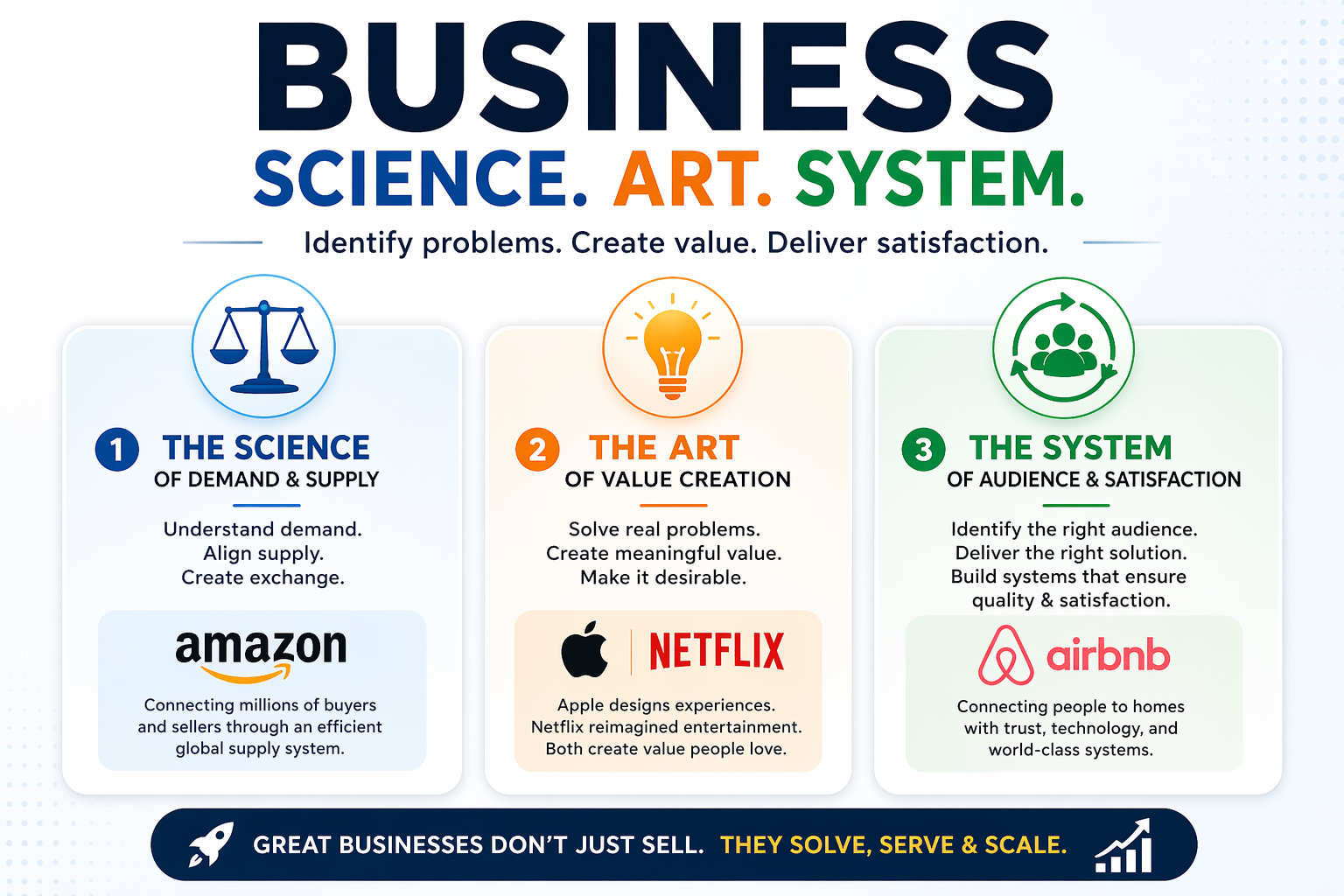
Business is often misunderstood as simply “buying and selling.” In reality, it is a structured system of problem-solving, value creation, and market coordination.
At its core, a business exists because problems exist in society—and value is created when those problems are solved efficiently and profitably.
Modern business thinking can be better understood through three complementary lenses:
- The science of demand and supply
- The art of value creation
- The system of audience, solution, and satisfaction delivery
Together, these definitions reveal that business is not random activity—it is a disciplined ecosystem of logic, creativity, and execution.
1. Business as the Science of Demand and Supply
Business begins with a simple but powerful economic principle: demand and supply.
At this level, business is the process of:
- Identifying unmet demand (problems, needs, or desires)
- Designing viable supply (products or services that solve them)
- Creating exchange systems where value moves efficiently
This aligns with classical economic theory where markets function through the interaction of demand and supply forces, determining value and pricing.
Real-world example: Amazon
is a clear example of demand-and-supply mastery.
- Demand: Customers wanted faster, more convenient access to products
- Supply solution: A global e-commerce marketplace with logistics infrastructure
- Result: A system that connects millions of buyers to sellers at scale
Amazon didn’t just sell products—it engineered one of the most efficient supply systems in modern history, transforming retail globally.
Key Insight
Businesses that fail often misread demand or misalign supply. Successful businesses build systems that continuously adjust both.
2. Business as the Art and Expertise of Value Creation
Beyond economics, business is also deeply creative and strategic.
It involves:
- Designing solutions that people actually want
- Packaging value in a compelling and usable form
- Differentiating offerings from competitors
- Turning ideas into utility and experience
This is why business is often described as both science and art—science provides structure, while art delivers appeal and differentiation.
Real-world example: Apple
demonstrates business as value creation mastery.
- Problem: Consumers needed personal technology that was simple and elegant
- Solution: Integrated ecosystem of hardware + software (iPhone, Mac, iOS)
- Value created: A premium experience, not just a device
Apple’s success is not just technical—it is deeply rooted in design thinking, branding, and emotional value creation.
Real-world example: Netflix
transformed entertainment by shifting from physical DVDs to digital streaming.
- Value created: On-demand access to global content
- Key innovation: Convenience + personalization
- Outcome: A completely new consumer behavior model in media consumption
Key Insight
Value is not just what a business produces—it is how that solution improves life, convenience, emotion, or efficiency.
3. Business as a System of Audience, Solution, and Satisfaction
The most operational definition of business is this:
Business is the process of identifying a target audience, connecting them to a solution, and ensuring satisfaction through structured systems.
This definition introduces the operational architecture of business, which includes:
(a) Target Audience Identification
Understanding:
- Who has the problem?
- How urgent is the need?
- What is their buying behavior?
(b) Solution Delivery
This involves:
- Product/service design
- Pricing strategy
- Distribution channels
(c) System Building
This is where most businesses succeed or fail:
- Customer service systems
- Quality control
- Feedback loops
- Operational consistency
Real-world example: Airbnb
is a perfect illustration of this system:
- Audience: Travelers needing affordable, flexible accommodation
- Solution: Peer-to-peer lodging marketplace
- System: Trust frameworks (reviews, identity verification, payments)
- Outcome: A global hospitality ecosystem without owning hotels
Airbnb’s strength is not just the idea—it is the system that ensures trust and satisfaction between strangers.
4. How These Three Definitions Work Together
A. Science (Demand & Supply) → Identifies Opportunity
At the foundational level, business begins with the disciplined observation of demand and supply dynamics. This is where market intelligence comes into play—understanding what people need, what they are willing to pay for, and where gaps exist. It requires analytical thinking: studying trends, consumer behavior, pricing sensitivity, and competitive landscapes. Businesses that excel here don’t guess; they validate demand before committing resources. This is how companies avoid building solutions nobody wants. In essence, the “science” phase filters noise from real opportunity, ensuring that every business idea is anchored in a verifiable market need rather than assumption.
B. Art (Value Creation) → Designs Solution
Once an opportunity is identified, the next phase is translating that insight into something meaningful—this is where the art of business comes in. Value creation is not just about solving a problem, but solving it in a way that is desirable, usable, and differentiated. It involves creativity, product design, branding, user experience, and emotional appeal. Two businesses may target the same problem, but the one that wins is often the one that delivers value more elegantly or memorably. This stage transforms raw opportunity into a compelling offering that people can connect with, trust, and choose over alternatives.
C. System (Execution & Satisfaction) → Delivers and Sustains Value
The final layer of business is systems—where ideas are operationalized and scaled. This involves building repeatable processes that ensure consistent delivery, quality control, and customer satisfaction. Without systems, even the best ideas collapse under inconsistency and inefficiency. This phase includes logistics, customer service frameworks, feedback mechanisms, and performance tracking. Strong systems not only deliver value but also sustain and improve it over time. Ultimately, this is what separates small, unstable ventures from scalable, enduring businesses—execution discipline backed by structured processes.
This is essentially what modern scholars describe as a business model—the logic of how value is created, delivered, and captured.
5. Why Many Businesses Fail Despite Good Ideas
Most failures happen not because of bad ideas, but because of breakdowns in one of the three areas:
- Misreading demand (no real market need)
- Weak value proposition (poor differentiation)
- Broken systems (poor delivery or customer experience)
For example:
- A great product without demand fails
- High demand without delivery systems collapses
- Strong systems without value creation stagnate
In Conclusion,
Business is not random hustle—it is a disciplined framework of economics, creativity, and systems design:
When these three elements align, businesses don’t just survive—they scale, dominate, and transform industries.
Over to You
Let’s make this interactive.
What insight did you gain from this post? Share your thoughts in the comments—someone else might learn from you too.