Project Life-Point (PLP): Why Most Businesses Fail Before They Succeed

Why do so many people start businesses, learn skills, or launch projects—only to give up before seeing results?
It’s not always lack of funding, ideas, or intelligence.
The real problem is simple: they stop too early.
This is where the concept of Project Life-Point (PLP) becomes important.
If you understand this concept, you will:
- Stay consistent longer
- Make better strategic decisions
- Increase your chances of success
What is Project Life-Point (PLP)?
Project Life-Point (PLP) is the stage where your consistent investment of time, effort, and resources begins to produce visible and sustainable results.
In simpler terms:
It is the point where your business, skill, or project starts to “pay off.”
Project Life-Point Explained (Visual Framework)
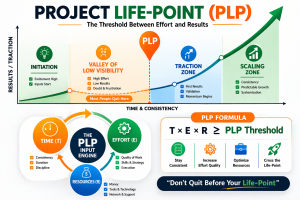
This framework shows a reality most people ignore:
- At the beginning, results are slow
- There is a long period of little or no visible progress
- Then suddenly, growth accelerates
That turning point is your Project Life-Point.
The Valley of Low Visibility: Where Most People Quit
Before reaching your Life-Point, every project enters a difficult phase called:
The Valley of Low Visibility
This is where:
- You are working consistently
- You are improving your skills
- But results are not yet visible
This stage creates:
- Doubt
- Frustration
- Loss of motivation
And this is exactly where most people quit.
Why Results Take Time
Success is not instant—it is cumulative.
Think of it like pumping water:
- You pump repeatedly
- Nothing happens at first
- Then suddenly, water starts flowing
Your effort is not wasted—it is building toward a threshold.
The 3 Factors That Determine Your Success
Your ability to reach your Project Life-Point depends on three key factors:
1. Time (Consistency)
- Showing up daily or weekly
- Staying committed over months
2. Effort (Execution Quality)
- Learning the right skills
- Applying the right strategies
3. Resources (Support System)
- Tools and technology
- Mentorship and network
- Financial support
The Success Formula
Time × Effort × Resources ≥ Life-Point Threshold
If any of these is weak, your progress slows down.
The 4 Stages of Business and Skill Growth
1. Initiation Stage
- Excitement is high
- You are just starting
2. Valley of Low Visibility
- Effort increases
- Results remain low
Most people quit here.
3. Breakthrough Stage (Life-Point)
- First results appear
- You gain confidence
4. Scaling Stage
- Growth becomes predictable
- Systems are built
Real Company Case Studies
1. Amazon — From Losses to Dominance
Amazon is a global technology company focused on e-commerce, cloud computing (AWS), digital streaming, and logistics infrastructure. It began as an online bookstore and evolved into one of the most diversified digital ecosystems in the world. With an Approx. Valuation: ~$1.5–$1.8 trillion (fluctuates with market), Amazon built the world’s largest online marketplace, created Amazon Web Services (AWS), a dominant global cloud platform and revolutionized logistics and last-mile delivery systems
Timeline Insight
- Founded: 1994 by Jeff Bezos
- Profitability: ~2003
- Pre-PLP Duration: ~9 years
The Valley of Low Visibility
- Continuous losses for years
- Investor skepticism (“just an online bookstore”)
- Heavy reinvestment in infrastructure and logistics
What Drove Their PLP?
- Time: Relentless long-term commitment
- Effort: Operational excellence, logistics innovation
- Resources: Reinvestment of revenue into growth
Life-Point Moment
- Sustainable profitability + expansion into multiple categories
- Later amplified by AWS (new revenue engine)
Takeaway
Amazon didn’t “succeed early”—it outlasted the valley.
2. Tesla — Innovation Before Acceptance
How to Reach Your Life-Point Faster
1. Improve Your Skills
Stop guessing. Learn from structured training.
2. Stay Consistent
Commit to a realistic timeframe (at least 60–90 days).
3. Use Better Resources
Leverage tools, mentors, and proven systems.
Real-Life Example
A beginner in digital marketing may:
Before Life-Point:
- Post content with no engagement
- Learn without earning
After Life-Point:
- Get first clients
- Receive referrals
- Earn consistent income
The difference is not luck—it is persistence.
Final Thought: Don’t Quit Too Early
Most people don’t fail because they lack potential.
They fail because they stop before results appear.
Your success may be closer than you think.
Don’t quit before your Project Life-Point.
What Next?
If you want to reach your Life-Point faster:
- Enroll in our practical training programs at Jomo Resource Center
- Learn high-income digital and business skills
- Get structured guidance and support
Click here to view our courses
Bonus: Self-Check
Ask yourself:
- Am I consistent enough?
- Is my effort strategic or random?
- Do I have the right support system?
Fix these—and your breakthrough becomes inevitable.
Over to You
Found this inspiring? I’d love to hear from you.
What’s one thing you learned from this post? Share it in the comments below.