

Validate a Business Idea Before You Waste Money | Smart Startup Validation Guide

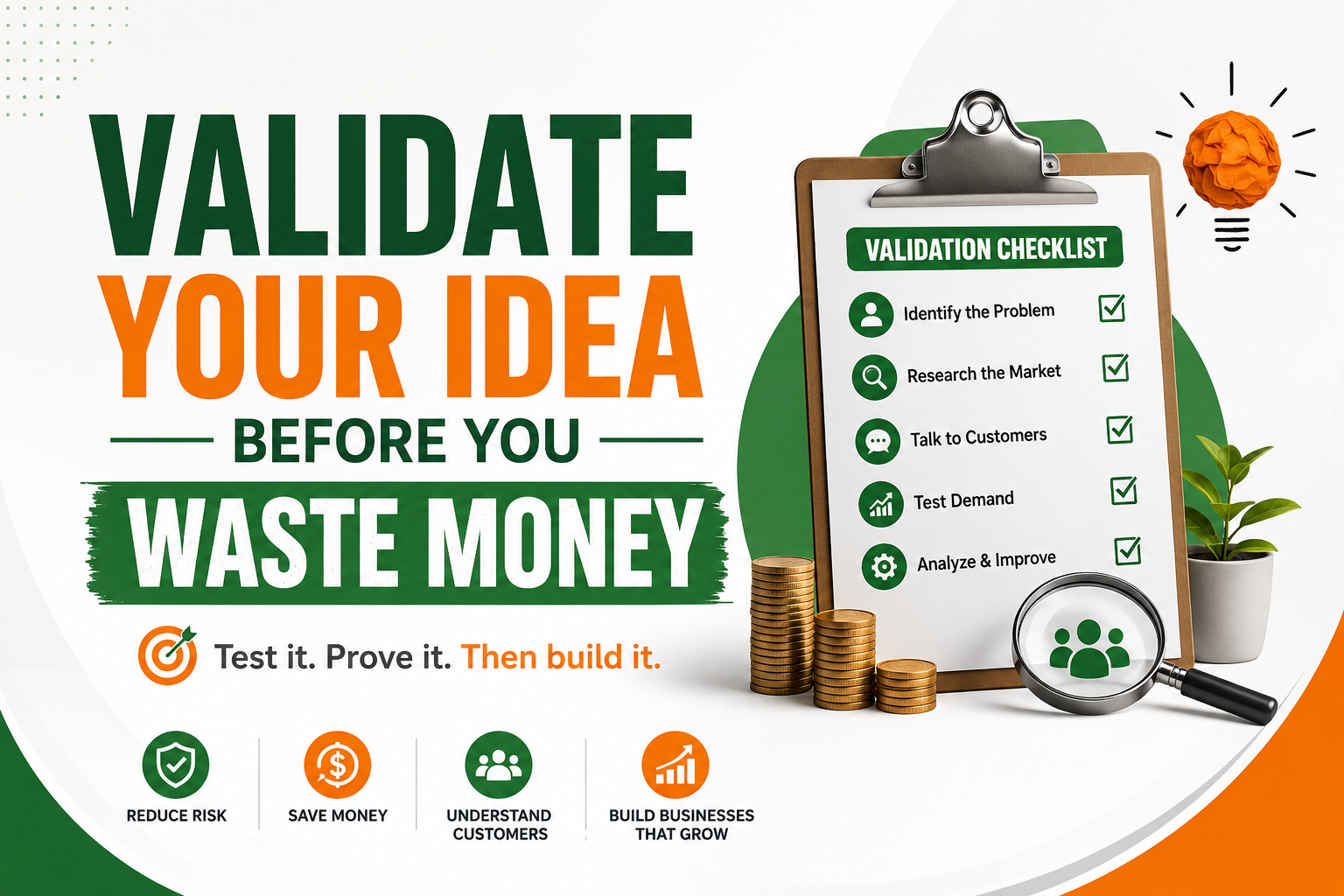
Starting a business can feel exciting. You get inspired, create a logo, buy a domain name, print flyers, build a website, and maybe even rent an office space. But here’s the uncomfortable truth:
Most failed businesses did not fail because the founders were lazy.
They failed because they built something people didn’t actually want.
According to multiple startup studies, one of the biggest reasons startups fail is lack of market demand. In simple terms, founders invest heavily into ideas without properly validating whether real customers truly need the solution.
That’s where smart entrepreneurs think differently.
Before spending huge amounts of money, time, and emotional energy, successful founders validate a business idea first. They test assumptions, study customer behavior, analyze demand, and gather real-world evidence before scaling.
In today’s digital economy, validation is no longer optional. Whether you’re launching a tech startup, online business, consulting service, side hustle, or physical store, business idea validation can save you from expensive mistakes.
This guide will show you exactly how to validate a business idea using practical, low-cost, and modern startup validation strategies that reduce risk and increase your chances of success.
What It Means to Validate a Business Idea
To validate a business idea means proving that people genuinely want your solution and are willing to pay for it.
Validation is the process of replacing assumptions with evidence.
Many entrepreneurs operate based on thoughts like:
- “I think people will buy this.”
- “My friends said it’s a good idea.”
- “Nobody else is doing this.”
- “I’m passionate about it, so it will work.”
Unfortunately, passion alone does not create a profitable business.
Real validation happens when you gather proof from the market itself.
Assumptions vs Evidence
Assumption:
“Busy professionals need healthy meal plans.”
Evidence:
- 300 people joined your waitlist
- 50 people completed a survey
- 20 customers prepaid for trial meals
- Social media ads generated strong engagement
That’s the difference between guessing and validating.
Why Business Idea Validation Matters
When you validate business concepts early, you:
- Reduce financial risk
- Avoid building unwanted products
- Understand your target audience better
- Improve your business model
- Discover market opportunities faster
- Save time and resources
- Increase investor confidence
Most importantly, validation helps you solve real problems instead of imagined ones.
Common Reasons Business Ideas Fail
Understanding why businesses fail can help you avoid the same traps.
1. No Market Demand
This is the biggest startup killer.
Many founders create products nobody urgently needs. A “cool idea” is not enough. If customers don’t see value, the business struggles.
2. Poor Timing
Sometimes the market simply isn’t ready.
An idea may be too early, too expensive for the audience, or launched during unfavorable economic conditions.
3. Weak Differentiation
If customers can’t clearly understand why your business is different or better, competitors will dominate.
4. Ignoring Customer Feedback
Some founders fall in love with their idea and refuse to adapt. They ignore warnings from the market.
That’s dangerous.
5. Building Based on Passion Alone
Passion is important, but businesses survive through customer demand, not emotions.
6. Lack of Research
Skipping business market research often leads to wrong pricing, poor targeting, and unrealistic expectations.
Signs Your Business Idea Has Potential
Before you invest heavily, look for these positive indicators.
Clear Customer Pain Points
Strong businesses solve frustrating, urgent, or expensive problems.
If people constantly complain about an issue, that’s usually a good sign.
Existing Demand
A market already spending money is usually healthier than a completely untested market.
Competition is not always bad. It often proves demand exists.
Repeatable Problems
Recurring problems create recurring revenue opportunities.
For example:
- Monthly bookkeeping
- Marketing services
- Subscription software
- Maintenance services
Strong Niche Opportunities
Specific audiences are often easier to target than broad markets.
Instead of:
“Fitness for everyone”
Try:
“Fitness coaching for busy mothers working remotely”
Market Trends Support the Idea
Study emerging trends:
- Remote work
- AI adoption
- Digital payments
- E-learning
- Creator economy
- Health technology
Trends can accelerate startup growth.
People Already Seek Solutions
Search behavior matters.
If people actively search online for solutions, tools, or alternatives, your market may already exist.
Step-by-Step Process to Validate a Business Idea
Now let’s explore exactly how to test a business idea properly.
Step 1: Define the Problem Clearly
Many entrepreneurs start with a product instead of a problem.
That’s backwards.
Successful businesses begin with understanding customer frustrations deeply.
Identify Your Target Audience
Ask:
- Who specifically has this problem?
- What age group?
- What profession?
- What location?
- What income level?
- What habits do they have?
The more specific your audience, the easier validation becomes.
Understand Their Pain Points
Dig deeper:
- What frustrates them daily?
- What wastes their time?
- What costs them money?
- What emotional stress do they experience?
Pain creates demand.
Clarify Your Value Proposition
Your value proposition should answer:
- What problem do you solve?
- Who do you solve it for?
- Why is your solution better?
Example:
“We help small businesses automate customer support using AI chat systems.”
Clear beats clever.
Step 2: Research the Market
Proper business market research prevents costly blind spots.
Analyze Competitors
Study:
- Their pricing
- Customer reviews
- Marketing strategy
- Weaknesses
- Popular features
- Customer complaints
Competitor research reveals gaps you can exploit.
Study Industry Trends
Use:
- Google Trends
- Industry reports
- YouTube discussions
- Reddit communities
- LinkedIn conversations
- Market forecasts
You want to understand where the market is heading.
Conduct Keyword Research
Keyword research helps reveal customer intent.
Look for:
- Search volume
- Questions people ask
- Buying-related searches
- Problem-focused keywords
This is one of the most overlooked market validation strategies.
Understand Customer Behavior
Observe:
- What customers currently buy
- Where they spend time online
- What influences purchasing decisions
- What objections they have
Behavior reveals reality faster than opinions.
Estimate Market Size
A small niche can still be profitable, but you should know:
- Total potential customers
- Spending power
- Growth opportunities
- Competition intensity
Step 3: Talk to Real Potential Customers
One of the fastest ways to validate a business idea is direct conversation.
Not assumptions. Not guessing. Real conversations.
Use Surveys Carefully
Tools like Google Forms work well for:
- Customer preferences
- Pain point discovery
- Pricing feedback
- Feature prioritization
However, avoid leading questions.
Bad question:
“You would buy this amazing product, right?”
Better question:
“How are you currently solving this problem?”
Conduct Interviews
Short interviews provide deeper insight.
Ask:
- What frustrates you most about this problem?
- What solutions have you tried?
- What do you dislike about current options?
- Would you pay for a better solution?
Listen more than you speak.
Join Communities
Online communities are goldmines for customer validation.
Explore:
- Facebook groups
- Reddit threads
- LinkedIn groups
- Discord communities
- Industry forums
Pay attention to repeated complaints and unmet needs.
Use Social Media Feedback
Post ideas publicly and monitor:
- Comments
- Shares
- Questions
- DMs
- Engagement levels
People reveal interest through interaction.
Step 4: Test Demand Before Building
This is where smart founders separate themselves from emotional entrepreneurs.
Don’t fully build first.
Test demand first.
Create a Landing Page
A simple landing page can validate interest quickly.
Include:
- Problem statement
- Solution overview
- Benefits
- Email signup form
- Call-to-action
Track how many people join your waitlist.
Launch a Waitlist
Waitlists create early validation.
If nobody signs up, the problem may not feel urgent enough.
Accept Pre-Orders
Pre-orders are powerful proof of concept business validation.
People paying upfront matters more than compliments.
Build an MVP (Minimum Viable Product)
An MVP is the simplest version of your solution.
It should:
- Solve one core problem
- Require minimal resources
- Gather customer feedback quickly
Don’t overbuild.
Test Through Social Media
Run small experiments:
- Short videos
- Problem-focused posts
- Paid ads
- Polls
- Educational content
Observe response patterns carefully.
Offer Pilot Programs
Instead of scaling immediately:
- Work with a few early users
- Offer discounted trials
- Gather testimonials
- Improve based on feedback
Pilot programs reduce startup risk dramatically.
Step 5: Analyze Feedback and Data
Validation is meaningless if you ignore the data.
Monitor Engagement
Look for:
- Email signups
- Click-through rates
- Comments
- Shares
- Watch time
- Replies
Engagement suggests interest.
Measure Conversion Signals
The strongest validation signals include:
- Payments
- Pre-orders
- Booked calls
- Trial signups
- Repeat usage
Attention alone is not enough.
Listen to Customer Objections
Objections reveal opportunities.
Examples:
- “Too expensive”
- “Too complicated”
- “I don’t trust it yet”
- “I already use another solution”
Each objection helps improve positioning.
Evaluate Buying Intent
There’s a major difference between:
“That’s interesting.”
And:
“How can I buy?”
Learn to recognize the difference.
Low-Cost Ways to Validate a Business Idea
You do not need massive funding to start startup validation.
Here are affordable methods.
Google Forms
Simple surveys help gather early customer insights.
Social Media Polls
Quick polls on Instagram, LinkedIn, or Facebook can reveal audience preferences.
Free Communities
Communities provide direct access to real conversations.
Freelance Testing
Offer your service manually before building software or automation.
For example:
Before creating an AI agency, manually deliver the service first.
Content Marketing
Write educational content around the problem you solve.
If people engage consistently, demand may exist.
Small-Scale Offers
Instead of launching fully:
- Sell to 5 customers first
- Run a mini workshop
- Offer beta access
- Test one location
- Start with a niche audience
Small tests create valuable learning.
Validation Mistakes Entrepreneurs Make
Even smart founders make validation errors.
Asking Biased Questions
People naturally want approval.
But biased questions produce misleading results.
Ignoring Negative Feedback
Criticism can save your business.
Don’t dismiss uncomfortable feedback too quickly.
Building Too Early
Many founders spend months building before confirming demand.
That’s risky.
Overinvesting Too Fast
Expensive branding, offices, equipment, or software should come later.
Validate first.
Assuming Friends Are Customers
Friends often encourage ideas emotionally.
Markets behave differently.
Confusing Interest With Payment Intent
Likes and compliments are not revenue.
Real validation happens when people commit money, time, or referrals.
How to Know When Your Idea Is Truly Validated
So how do you know your business idea validation is actually working?
Look for patterns.
Repeat Demand
People consistently ask for the solution.
Customers Willing to Pay
This is critical.
Payment validates seriousness.
Consistent Interest
Traffic, signups, and inquiries continue over time.
Organic Referrals
People naturally recommend your solution to others.
That’s a powerful signal.
Early Sales
Even small sales prove market potential.
Positive Feedback Patterns
Repeated compliments around the same value proposition indicate strong positioning.
Mini Case Study: How Sarah Validated Her Online Business
Sarah worked as a virtual assistant and noticed many small business owners struggled with email management.
Instead of immediately building a SaaS platform, she validated the business concept first.
Here’s what she did:
- Interviewed 25 small business owners
- Identified common frustrations
- Offered manual inbox management services
- Created a simple landing page
- Shared educational LinkedIn content
- Collected testimonials
- Secured 10 paying clients
Only after consistent demand did she invest in software automation.
Because she validated first:
- She avoided unnecessary development costs
- Understood customer priorities
- Built features customers actually wanted
- Generated revenue early
That’s lean startup thinking in action.
Expert Tips for Smarter Business Validation
Start Narrow Before Expanding
Winning a niche market first is easier than targeting everyone.
Charge Earlier Than You Feel Comfortable
Early payment reveals genuine demand.
Focus on Customer Behavior, Not Opinions
What people do matters more than what they say.
Build Fast Feedback Loops
The faster you learn, the faster you improve.
Solve Expensive Problems
The more painful the problem, the easier monetization becomes.
Avoid Perfectionism
Perfection delays learning.
Validation requires speed and iteration.
Use Lean Startup Principles
Build → Measure → Learn
This cycle reduces waste dramatically.
Track Real Metrics
Monitor:
- Conversion rates
- Retention
- Customer acquisition cost
- Referral rates
- Repeat purchases
Metrics guide smarter decisions.
Finally,
The smartest entrepreneurs do not blindly gamble on ideas.
They validate a business idea carefully before scaling.
In today’s competitive market, assumptions are expensive. Validation reduces risk, improves decision-making, and increases your chances of building something customers genuinely want.
Before spending heavily:
- Research the market
- Talk to customers
- Test demand
- Analyze feedback
- Launch small
- Learn quickly
Remember:
A successful startup is not built on excitement alone. It is built on evidence.
So before you invest your savings, quit your job, hire a team, or build the “perfect” product, pause and validate business concepts first.
Your future business success may depend on it.