
Overcoming Procrastination: Practical Systems to Get More Done

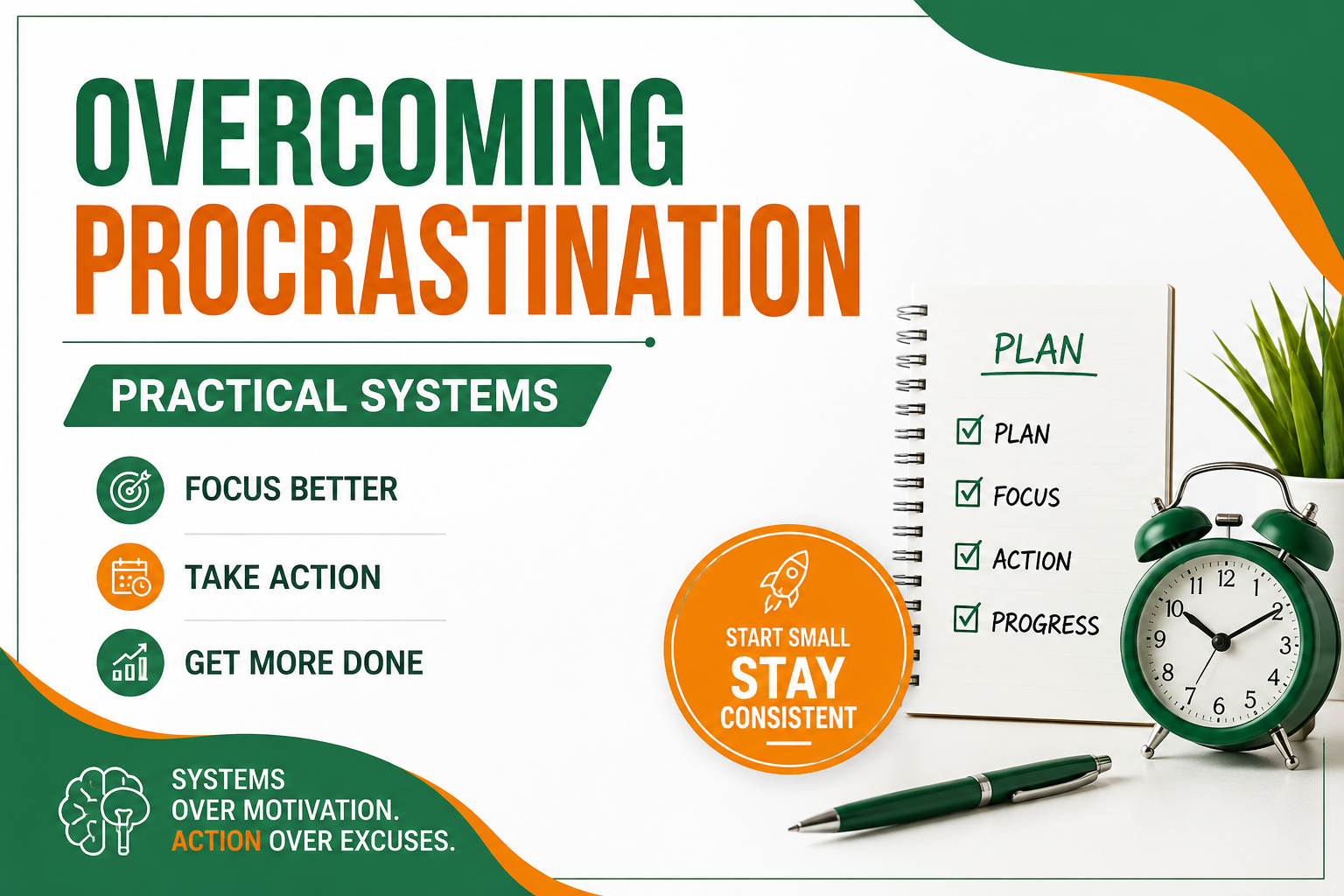
Why You Keep Delaying Important Things — And How to Finally Change It
You open your laptop to work on something important.
Maybe it’s a business proposal, a school assignment, content you promised to publish, a client project, or a personal goal you’ve been postponing for weeks.
You tell yourself, “I’ll start in a few minutes.”
Then somehow:
- You check social media
- Watch random videos
- Reply unnecessary messages
- Rearrange your workspace
- Read productivity tips instead of doing the actual work
Hours pass.
The guilt grows.
And the cycle repeats again tomorrow.
If this sounds familiar, you’re not lazy. You’re human.
The truth is that overcoming procrastination is rarely about “trying harder.” Most procrastination problems are actually caused by broken systems, emotional resistance, poor environment design, mental overload, and modern digital distractions.
That’s why motivation alone doesn’t work consistently.
People who seem highly productive usually don’t rely on feeling inspired every day. Instead, they use practical productivity systems that reduce friction, simplify action, and make consistency easier.
In this guide, you’ll learn:
- Why procrastination happens psychologically
- Why motivation keeps failing you
- Science-backed procrastination solutions
- Practical systems to stop delaying tasks
- Time management strategies that actually work
- How to build consistency without burnout
- Modern focus and productivity techniques for the digital age
If you’ve been searching for realistic ways to beat procrastination, this article will give you systems you can start using immediately.
What Procrastination Really Is
Many people think procrastination is laziness.
It’s not.
Procrastination is often emotional avoidance disguised as delay.
You postpone tasks because the task triggers uncomfortable emotions like:
- Anxiety
- Fear of failure
- Fear of judgment
- Overwhelm
- Self-doubt
- Mental fatigue
- Perfectionism
Your brain naturally seeks short-term emotional relief.
So instead of doing the difficult task, it chooses something easier and more rewarding — scrolling social media, watching videos, snacking, chatting, or doing “fake productive” activities.
This is why procrastination feels irrational.
You know what you should do, but your brain keeps pulling you away from it.
The Psychology Behind Procrastination
1. Emotional Avoidance
You’re not avoiding the task itself.
You’re avoiding the emotions connected to the task.
For example:
- A student delays studying because failure feels scary
- An entrepreneur delays launching because criticism feels painful
- A creator delays posting because imperfection feels uncomfortable
2. Perfectionism
Perfectionism is one of the biggest hidden causes of procrastination.
When people think:
- “It has to be excellent”
- “I need more preparation”
- “I’m not ready yet”
…they delay action endlessly.
Perfectionism creates paralysis.
3. Overwhelm
Large undefined tasks create mental resistance.
Your brain struggles with vague goals like:
- “Build my business”
- “Write the book”
- “Start the project”
Without clarity, your brain perceives the task as stressful and avoids it.
4. Dopamine-Driven Distractions
Modern apps are designed to hijack attention.
Social media platforms, notifications, short videos, and endless scrolling provide instant dopamine rewards.
Meanwhile, meaningful work usually offers delayed rewards.
Your brain naturally chooses immediate pleasure over long-term gain unless you intentionally build better productivity systems.
Why Motivation Alone Doesn’t Work
One of the biggest productivity myths is this:
“I’ll do it when I feel motivated.”
The problem?
Motivation is unreliable.
Some days you feel energized. Other days you feel tired, distracted, stressed, or mentally drained.
If your productivity depends entirely on motivation, consistency becomes impossible.
Systems Beat Motivation
Successful people rely less on motivation and more on:
- Routines
- Habits
- Environment design
- Scheduling systems
- Accountability
- Structure
They remove unnecessary decision-making.
Decision Fatigue Is Real
Every decision consumes mental energy.
If your day constantly requires deciding:
- What to work on
- When to start
- Where to begin
- Which task matters most
…your brain becomes exhausted before real work even starts.
That’s why practical productivity tips focus heavily on reducing friction and simplifying action.
Discipline vs Structure
People often overestimate discipline and underestimate structure.
A strong system can outperform willpower.
For example:
- Removing distracting apps is easier than resisting them constantly
- Scheduling focused work sessions is easier than “working whenever you feel like it”
- Pre-planning tasks reduces mental resistance
Structure creates consistency.
Practical Systems for Overcoming Procrastination
The 5-Minute Start Rule
One of the best procrastination solutions is deceptively simple:
Commit to working for just five minutes.
That’s it.
The goal is not completing the task.
The goal is reducing resistance.
Why It Works
Starting is usually the hardest part.
Once momentum begins, the brain becomes more willing to continue.
This technique works because:
- It lowers psychological pressure
- Makes tasks feel manageable
- Reduces fear and overwhelm
- Creates momentum quickly
Example
Instead of:
“I need to write an entire proposal.”
Tell yourself:
“I’ll work on this for five minutes.”
Most people continue once they begin.
Time Blocking
Time blocking is one of the most effective time management strategies for focus and productivity.
Instead of relying on vague intentions, you assign specific tasks to specific time periods.
Example Schedule
| Time | Task |
|---|---|
| 8:00–9:00 AM | Deep work |
| 9:00–9:30 AM | Emails/messages |
| 10:00–12:00 PM | Project work |
| 1:00–2:00 PM | Meetings |
| 3:00–4:00 PM | Creative tasks |
Benefits
- Reduces decision fatigue
- Creates structure
- Protects productive hours
- Improves focus
- Limits distractions
Task Chunking
Large tasks create procrastination.
Small tasks create momentum.
Instead of:
“Build my website.”
Break it into:
- Choose domain name
- Buy hosting
- Design homepage
- Write About page
- Upload logo
Smaller actions reduce overwhelm and increase clarity.
Environment Design
Your environment shapes your behavior more than you realize.
If distractions are constantly available, procrastination becomes easier.
Improve Your Workspace
- Keep your phone out of reach
- Close unnecessary tabs
- Use website blockers
- Keep workspace clean
- Prepare tools before work begins
- Reduce noise interruptions
Make Good Habits Easier
Behavioral psychology shows that humans naturally follow the path of least resistance.
So:
- Put books within reach
- Keep work materials visible
- Use full-screen mode while working
- Remove distracting apps from your home screen
Design your environment for focus.
Accountability Systems
Accountability dramatically improves follow-through.
When someone expects progress from you, procrastination decreases.
Accountability Ideas
- Work with an accountability partner
- Join productivity communities
- Use public commitments
- Share weekly goals
- Track daily progress visibly
Even simple checklists can improve consistency.
The “Done Before Perfect” System
Perfectionism destroys execution.
Many people delay progress because they want everything flawless before taking action.
But progress usually comes from iteration.
Replace This:
“It must be perfect.”
With This:
“It must be completed.”
High performers understand:
- Imperfect action beats endless planning
- Feedback improves quality
- Momentum creates confidence
Execution matters more than perfection.
Energy Management
Not all hours are equal.
Some people think productivity is purely about time management.
But energy management matters just as much.
Identify Your Peak Energy Hours
Ask yourself:
- When do I focus best?
- When am I mentally sharpest?
- When do I feel most creative?
Use high-energy periods for important work.
Protect Your Energy
- Sleep properly
- Take movement breaks
- Hydrate consistently
- Avoid excessive multitasking
- Schedule recovery time
Burnout increases procrastination.
Digital Distractions and Productivity
Modern technology makes focus harder than ever.
Many people are not struggling with laziness.
They are struggling with constant interruption.
Social Media Addiction
Apps are engineered to maximize attention.
Infinite scrolling, notifications, and short-form videos train your brain to seek constant stimulation.
As a result:
- Deep focus becomes difficult
- Patience decreases
- Attention span weakens
Notification Overload
Every notification breaks concentration.
Research consistently shows that recovering focus after interruptions can take significant time.
Reduce Digital Noise
- Turn off nonessential notifications
- Use “Do Not Disturb”
- Schedule phone-checking windows
- Keep devices away during deep work
The Myth of Multitasking
Multitasking feels productive.
But most of the time, it reduces performance.
Your brain switches rapidly between tasks, wasting mental energy.
Single-tasking improves:
- Accuracy
- Focus
- Speed
- Cognitive performance
Deep Work Principles
Deep work means uninterrupted concentration on cognitively demanding tasks.
To Practice Deep Work:
- Work in distraction-free blocks
- Use timers
- Eliminate interruptions
- Focus on one important task
- Schedule recovery afterward
Deep work produces higher-quality results faster.
How to Build Consistency Instead of Waiting for Motivation
Habit Stacking
Habit stacking connects a new habit to an existing one.
Example
- After morning coffee → review goals
- After lunch → 15 minutes deep work
- Before bed → plan tomorrow
This reduces mental resistance.
Identity-Based Habits
Behavior changes more effectively when connected to identity.
Instead of saying:
“I’m trying to be productive.”
Say:
“I’m someone who follows through.”
Identity shapes behavior.
Build Momentum Daily
Consistency matters more than intensity.
Small daily actions create long-term results.
Even:
- 20 focused minutes
- One completed task
- One important action
…can build momentum.
Reward Systems
Your brain responds to rewards.
Celebrate progress intentionally.
Examples:
- Short break after focused work
- Favorite snack after task completion
- Leisure time after deep work session
Positive reinforcement strengthens habits.
Common Productivity Mistakes People Make
1. Unrealistic Planning
Overloading schedules creates frustration.
People often underestimate how long tasks actually take.
2. Depending on Motivation
Motivation fluctuates.
Systems remain.
3. Ignoring Sleep
Sleep deprivation weakens:
- Focus
- Decision-making
- Emotional control
- Self-discipline
4. Lack of Prioritization
Not every task matters equally.
Learn to identify high-impact activities.
5. Constant Busyness
Being busy is not the same as being productive.
Many people stay occupied while avoiding meaningful work.
The Role of Mindset in Overcoming Procrastination
Your mindset strongly affects productivity psychology.
Self-Talk Matters
Negative self-talk increases avoidance.
Statements like:
- “I always procrastinate”
- “I’m lazy”
- “I never finish anything”
…reinforce unhelpful behavior.
Replace them with:
- “I’m improving my systems.”
- “I can start small.”
- “Progress matters more than perfection.”
Fear Management
Fear often hides beneath procrastination.
The solution is not eliminating fear completely.
The solution is acting despite discomfort.
Confidence grows through action, not waiting.
Growth Mindset
People with growth mindsets believe improvement is possible through practice.
Mistakes become learning opportunities instead of proof of failure.
That mindset reduces paralysis.
Practical Daily Productivity Routine Example
Here’s a realistic structure readers can adapt.
Morning
- Wake up consistently
- Avoid phone immediately
- Review top 3 priorities
- Start hardest task early
Midday
- Time-block focused work
- Take movement breaks
- Limit social media usage
Afternoon
- Handle meetings/messages
- Complete smaller tasks
- Review progress
Evening
- Plan tomorrow
- Reflect briefly
- Reduce screen stimulation before sleep
The goal isn’t perfection.
The goal is consistency.
Real-Life Example: How David Beat Chronic Procrastination
David was a freelance graphic designer who constantly missed deadlines.
He blamed laziness.
But after reflecting honestly, he realized the real problems were:
- Perfectionism
- Poor structure
- Social media distractions
- Unrealistic planning
Instead of chasing motivation, he changed his systems.
He:
- Used time blocking
- Deleted distracting apps during work hours
- Started using the 5-minute rule
- Broke projects into smaller tasks
- Created accountability with another freelancer
Within three months:
- His project completion rate improved dramatically
- Stress reduced
- Income increased
- Confidence improved
The biggest change?
He stopped waiting to “feel ready.”
He built systems that made action easier.
Expert Tips for Staying Productive Long-Term
1. Prioritize Sustainability
Extreme productivity routines often fail.
Choose systems you can maintain realistically.
2. Focus on Consistency
Small repeated actions outperform occasional intense effort.
3. Protect Your Attention
Attention is one of your most valuable resources.
Guard it carefully.
4. Review Weekly
Evaluate:
- What worked
- What distracted you
- What needs adjustment
5. Accept Imperfect Days
You will still have off days.
That’s normal.
The goal is returning quickly instead of quitting entirely.
Finally,
Action Creates Momentum
Overcoming procrastination is not about becoming a perfectly disciplined robot.
It’s about understanding human psychology and building systems that make action easier.
Motivation comes and goes.
But practical productivity systems create consistency.
If you want to stop procrastinating:
- Start before you feel ready
- Break tasks into smaller actions
- Reduce distractions
- Protect your energy
- Build routines
- Focus on progress over perfection
Most importantly, remember this:
Momentum usually comes after action — not before it.
So don’t wait for the perfect mood, perfect time, or perfect motivation.
Start small.
Start messy.
But start.