How to Stand Out in a Crowded Job Market Without Experience

If you’ve ever thought, “How do I get a job when every role requires experience?” — you’re not alone. This is one of the most frustrating realities for fresh graduates, NYSC corps members, and career switchers across Nigeria and Africa.
The truth is, many job seekers are stuck in the same cycle: no experience, no job… and no job, no experience.
But here’s what most people miss — employers are not just hiring experience. They are hiring value, potential, and positioning.
In this article, you’ll learn exactly how to stand out in a crowded job market, even if you’re starting from zero. These are practical, proven strategies you can start applying immediately.
But first, let’s look at the
The Reality of Today’s Job Market
The job market today is more competitive than ever. Thousands of candidates apply for the same role, often using the same approach:
- Same CV format
- Same generic applications
- Same “I am hardworking and passionate” statements
This is why many applications go unnoticed.
Why Traditional Methods Fail
Relying only on your degree or certificate is no longer enough. Employers are asking:
- What can you actually do?
- Can you solve real problems?
- How quickly can you add value?
This means the game has shifted from qualification → to positioning.
If you want to stand out in a crowded job market, you must deliberately position yourself differently from the average applicant.
So, here are the
Key Strategies to Stand Out without Work Experience:
1. Build a Skill-Based CV Instead of Experience-Based
If you don’t have job experience, don’t try to make up one — replace it instead.
Focus your CV on:
- Skills (e.g., digital marketing, data analysis, customer service)
- Tools (e.g., Excel, Canva, Google Docs)
- Results from personal or academic projects
Example:
Instead of writing:
“No work experience” or making up something to cover up,
Write:
“Developed a social media content plan that increased engagement by 40% during a personal project.”
This approach answers the real question: What can you do?
2. Create Proof of Work (Projects, Portfolio, Case Studies)
One of the fastest ways to stand out in a crowded job market is to show evidence of your ability.
You don’t need a job to create such evidence.
What you can do:
- Design mock projects (e.g., branding for a fictional company)
- Volunteer to manage a small business’s social media
- Build case studies from personal experiments
Example:
If you’re interested in digital marketing:
- Run a small Instagram page
- Track growth
- Document results
This becomes your portfolio, and it speaks louder than any CV.
3. Leverage Personal Branding (Especially LinkedIn)
Your online presence is your digital first impression.
Most recruiters now search candidates online before making decisions.
To build your brand:
- Optimize your LinkedIn headline (not just “Graduate”)
- Share insights from what you’re learning
- Post weekly about your journey and projects
Example Headline:
“Entry-Level Data Analyst | Excel & Power BI | Turning Data into Insights”
Consistency here can significantly improve how you stand out in a crowded job market.
4. Learn In-Demand Skills Quickly
If you’re wondering how to get a job without experience, this is critical.
Focus on skills that are:
- Marketable
- Learnable within 30–90 days
- Applicable across industries
High-demand skills in Nigeria/Africa:
- Digital marketing
- Data analysis
- UI/UX design
- Content writing
- Customer support tools
You don’t need to master everything — just become competent enough to deliver value.
5. Network Strategically (Not Randomly)
Networking is not about begging for jobs — it’s about building relationships.
Smart networking includes:
- Connecting with professionals in your field
- Asking informed questions
- Engaging with their content
What to avoid:
- “Please help me with a job” messages
- Copy-paste outreach
Better approach:
“Hello [Name], I’m currently learning [skill] and I admire your work in [field]. What advice would you give someone starting out?”
This positions you as someone serious and intentional.
6. Apply Smart, Not Hard
Many job seekers apply to 100 jobs with zero response.
That’s not strategy — that’s noise.
To improve your chances:
- Tailor your CV to each role
- Use keywords from the job description
- Focus on quality over quantity
This is one of the most overlooked job search tips for beginners.
7. Use Internships, Volunteering & Freelancing as Leverage
If companies won’t hire you yet, create your own entry point.
Options:
- Internships (paid or unpaid)
- Volunteering for NGOs or startups
- Freelancing on small projects
These give you:
- Real-world experience
- References
- Confidence
And most importantly — something to show.
Common Mistakes to Avoid
Even with good intentions, many candidates sabotage their chances.
1. Using Generic CVs
Sending the same CV everywhere signals laziness and lack of focus.
2. Applying Blindly
Applying without understanding the role reduces your chances significantly.
3. Waiting to “Feel Ready”
You don’t need to be perfect — you need to be prepared enough to start.
4. Ignoring Your Online Presence
A weak or nonexistent online profile can cost you opportunities.
Practical 30-Day Action Plan
If you’re serious about learning how to get hired fast, follow this structured plan:
Week 1: Foundation & Clarity
- Choose a career path or role (e.g., digital marketing, HR, data analysis)
- Identify 1–2 in-demand skills in that field
- Start a basic online course
- Create or update your LinkedIn profile
Week 2: Skill Development & Proof
- Practice daily (at least 2–3 hours)
- Start a simple project
- Document your progress
- Begin building your portfolio
Week 3: Visibility & Networking
- Share your learning journey on LinkedIn
- Connect with 10–15 professionals in your field
- Engage with posts (comment thoughtfully)
- Reach out for insights, not jobs
Week 4: Applications & Positioning
- Prepare a tailored CV
- Apply to 5–10 relevant roles (targeted)
- Customize each application
- Follow up where possible
Consistency during these 30 days can dramatically improve your chances of breaking into the job market.
Finally,
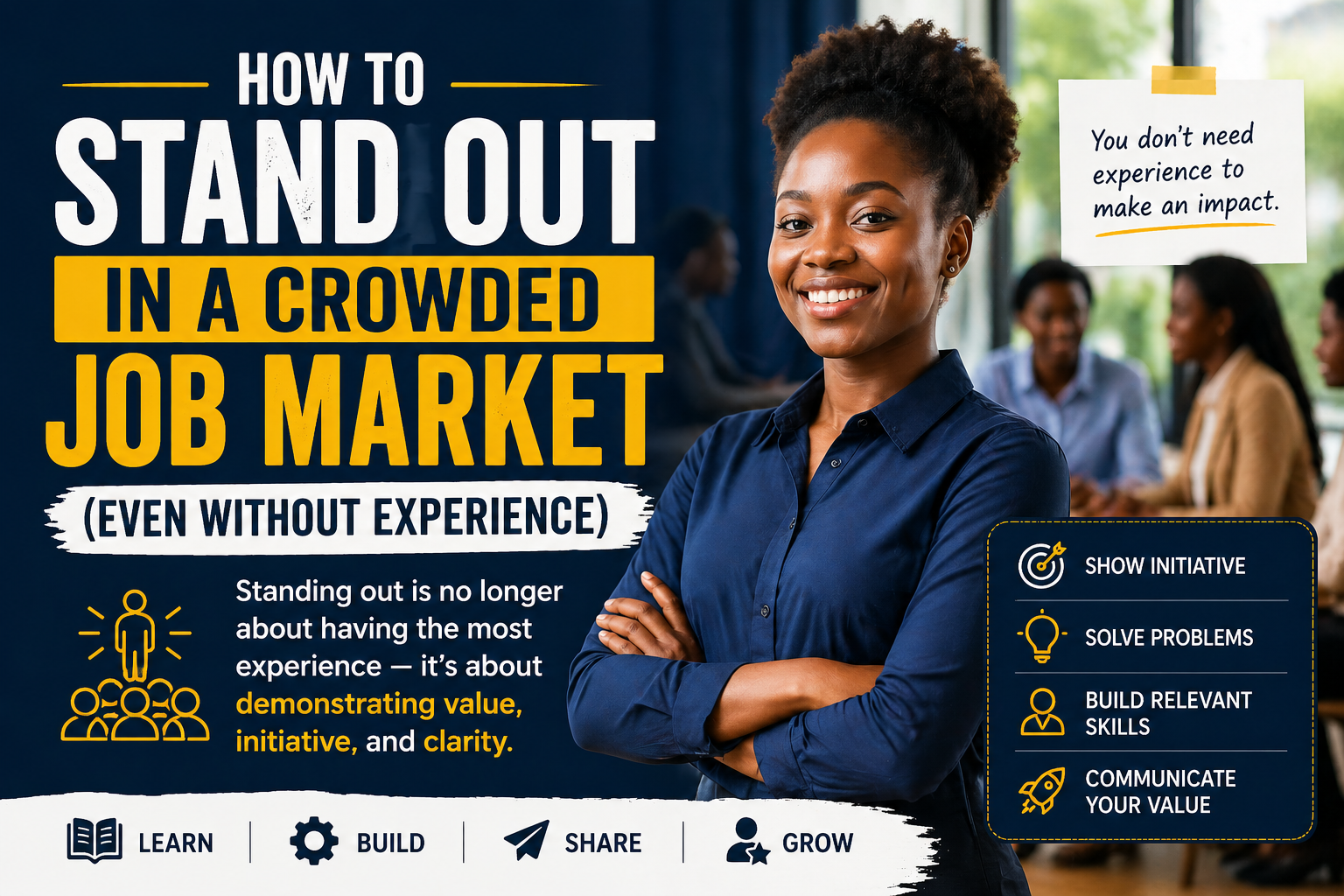
Standing out is no longer about having the most experience — it’s about demonstrating value, initiative, and clarity.
If you apply the strategies in this guide, you will not only stand out in a crowded job market, but you will also position yourself as someone employers cannot ignore.
Start small. Stay consistent. Build proof.
Because in today’s job market, those who take action — even imperfectly — always have the advantage.
Over to You
Found this inspiring? I’d love to hear from you.
What’s one thing you learned from this post? Share it in the comments below.