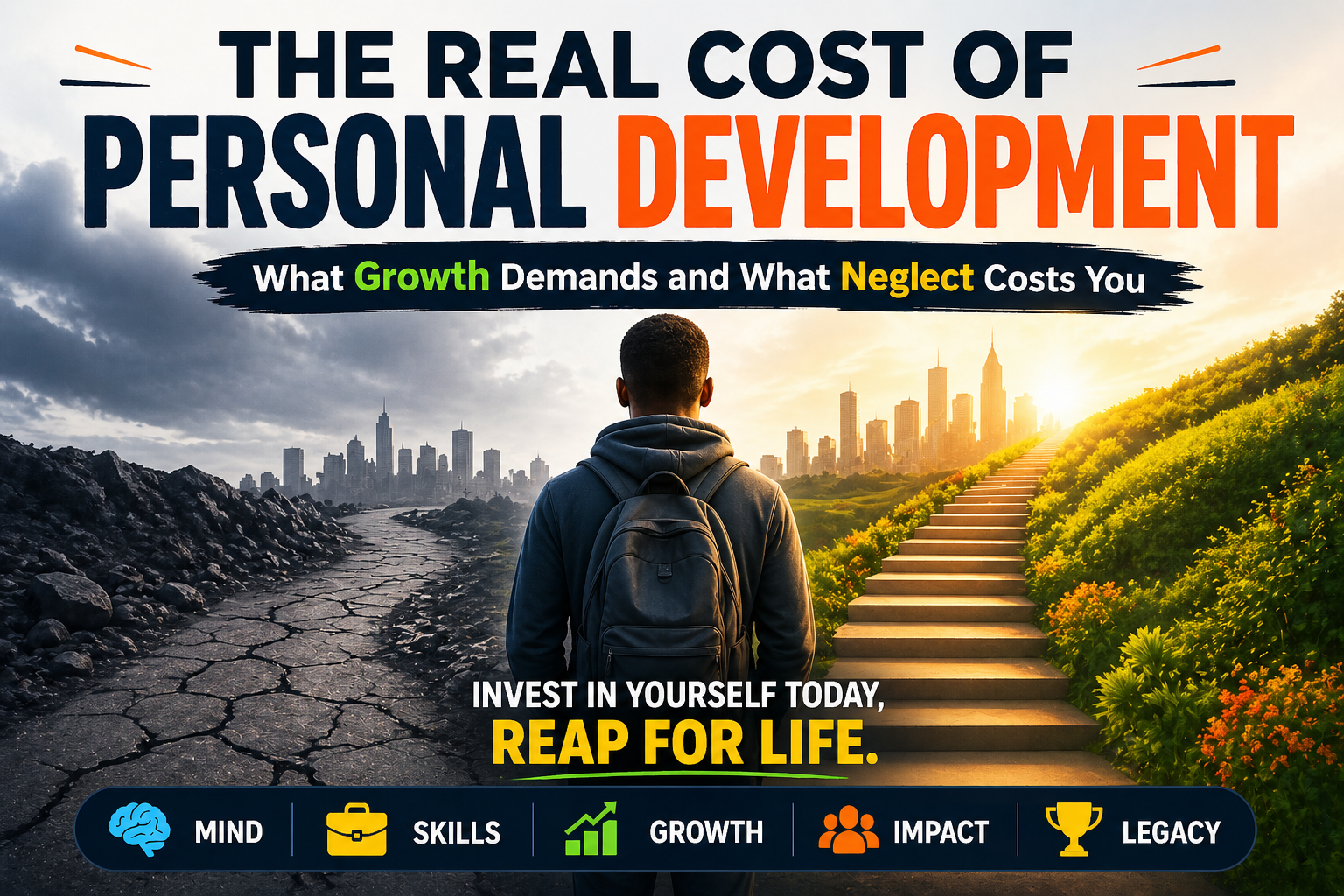
The Real Cost of Personal Development: What Growth Demands and What Neglect Costs You

There was a time when having a university degree, learning a trade, or mastering one technical skill was enough to secure a decent future. Today, that reality has changed dramatically.
A brilliant tailor can still struggle financially.
A talented graphic designer can remain invisible online.
A skilled artisan can lose customers because of poor communication.
A smart graduate can remain unemployed for years despite impressive certificates.
Why?
Because the modern economy no longer rewards technical ability alone. It rewards adaptability, professionalism, communication, innovation, emotional intelligence, business understanding, and digital competence.
This is the paradox of personal development:
The people who invest the most in improving themselves often sacrifice comfort today—but gain opportunities tomorrow.
Meanwhile, those who avoid the discomfort of growth often pay a far greater price later in life.
Personal development has a cost.
But stagnation is far more expensive.
In today’s world—especially across Africa and emerging economies where competition is rising rapidly—your future is increasingly determined not just by what you know, but by how well you evolve.
The market is changing.
Technology is changing.
Customer expectations are changing.
Business models are changing.
Artificial Intelligence is changing industries.
And the painful truth is this:
If you stop learning, you gradually become outdated.
This article explores the real cost of personal development from two critical perspectives:
- What growth demands from you
- What neglecting growth can cost you
You will also learn:
- The major forms of personal development
- The stages of growth and self-improvement
- Why technical skills alone are no longer enough
- The hidden reasons many talented people fail professionally
- Practical ways to grow personally, professionally, financially, and digitally
- How continuous learning, online courses, and business education can transform raw talent into sustainable success
Whether you are a student, entrepreneur, freelancer, artisan, job seeker, business owner, or working professional, this article will help you rethink what true growth really means in the modern economy.
What Is Personal Development?
Personal development is the intentional process of improving your knowledge, mindset, abilities, habits, emotional intelligence, productivity, and overall quality of life in order to become more effective personally and professionally.
It is not limited to motivational speeches or self-help books.
Personal development includes:
- Learning new skills
- Improving communication
- Building confidence
- Developing leadership ability
- Understanding technology
- Managing finances wisely
- Improving emotional intelligence
- Becoming more disciplined and adaptable
- Expanding business and professional capacity
In simple terms:
Personal development is the process of becoming a more valuable, capable, and effective version of yourself.
And in today’s economy, value matters.
Because opportunities often flow toward people who can solve problems effectively, communicate clearly, adapt quickly, and continuously improve themselves.
The Two Meanings of “Cost” in Personal Development
When people hear the phrase “cost of personal development,” they usually think about money spent on books, courses, mentorship, training, or education.
But the real cost is much deeper than money.
There are actually two major costs involved:
1. The Cost of Growth
Growth demands sacrifice.
It requires:
- Time
- Discipline
- Patience
- Consistency
- Financial investment
- Humility
- Emotional discomfort
- Delayed gratification
Personal development is not always convenient.
Sometimes it means:
- Waking up earlier to study
- Taking online courses after work
- Learning digital tools when others are relaxing
- Spending money on training instead of entertainment
- Facing criticism while improving
- Leaving comfort zones
- Starting again after failure
Growth stretches people.
And stretching is rarely comfortable.
But growth produces transformation.
2. The Cost of Neglecting Personal Development
This second cost is often invisible at first—but devastating over time.
The cost of neglect can include:
- Missed opportunities
- Career stagnation
- Poor income
- Business failure
- Low confidence
- Unemployment
- Irrelevance
- Poor decision-making
- Weak leadership ability
- Financial instability
Many people are not failing because they lack talent.
They are failing because they stopped growing.
And the world does not pause for anyone who refuses to evolve.
“If you are not improving, you are gradually becoming outdated.”
The Major Forms of Personal Development
Personal development is multidimensional. True growth requires improvement across different areas of life.
Let’s explore the major forms.
1. Intellectual Development
This involves expanding your knowledge, thinking capacity, creativity, and problem-solving ability.
It includes:
- Reading books
- Research
- Critical thinking
- Learning new concepts
- Exposure to ideas
- Mental discipline
People who stop learning often become mentally rigid and professionally limited.
Intellectual growth helps people make better decisions and adapt faster to changing environments.
2. Professional Development
Professional development focuses on becoming more competent and valuable in your career or industry.
It includes:
- Certifications
- Industry training
- Workplace skills
- Communication
- Leadership
- Project management
- Workplace ethics
- Productivity skills
A person may know how to do the work but still lack the professionalism needed to thrive in structured environments.
3. Financial Development
Many talented people remain financially unstable because nobody taught them financial intelligence.
Financial development includes learning:
- Budgeting
- Saving
- Investing
- Pricing
- Financial planning
- Profit management
- Wealth creation
A skilled entrepreneur who cannot manage money may still remain broke despite high income.
4. Emotional and Social Development
Success is deeply connected to human relationships.
This area focuses on:
- Emotional intelligence
- Communication
- Conflict resolution
- Confidence
- Networking
- Teamwork
- Self-awareness
People often lose opportunities not because they are unqualified—but because they lack emotional maturity or communication skills.
5. Digital and Technological Development
We live in a digital economy.
Every professional today needs some level of digital competence.
This includes:
- Computer literacy
- Online communication
- Digital marketing
- Social media use
- AI literacy
- Productivity tools
- Data handling
- Online branding
Businesses that ignore technology risk becoming irrelevant.
Professionals who ignore digital skills risk losing opportunities.
6. Business Development
Business development is essential for entrepreneurs, freelancers, artisans, and self-employed professionals.
It includes understanding:
- Branding
- Marketing
- Customer service
- Sales
- Business strategy
- Client retention
- Negotiation
- Operations
This is where many technically gifted people struggle.
7. Character and Spiritual Development
Skill without character is dangerous.
Character development includes:
- Integrity
- Discipline
- Responsibility
- Patience
- Honesty
- Purpose
- Ethical behavior
In the long run, character often determines sustainability.
People may gain opportunities through talent—but lose them through poor character.
Why Technical Skills Alone Are No Longer Enough
This is one of the most important realities of modern success.
Being technically skilled is important.
But it is no longer sufficient.
The market now rewards people who combine:
- Technical competence
- Business intelligence
- Communication
- Digital literacy
- Professionalism
- Emotional intelligence
- Marketing ability
- Adaptability
Let’s look at practical examples.
The Tailor Who Is Talented but Always Broke
A tailor may sew excellent clothes.
But if they lack:
- Customer service
- Social media visibility
- Branding
- Time management
- Communication
- Financial management
…customers may stop returning.
Another tailor with slightly lower sewing skills but better professionalism and online visibility may attract more clients and earn significantly more.
Why?
Because modern success is no longer based on skill alone.
It is based on value delivery and market positioning.
The Designer Nobody Knows
A graphic designer may be incredibly talented.
But if they:
- Cannot communicate professionally
- Fail to market themselves
- Ignore LinkedIn and online portfolios
- Miss deadlines
- Lack networking ability
…they may struggle to grow.
Meanwhile, another designer with moderate talent but stronger business and communication skills may secure international clients.
The Skilled Artisan with Poor Customer Experience
Some artisans lose opportunities because of:
- Poor attitude
- Failure to respond to messages
- Lack of professionalism
- Inability to explain pricing
- Weak negotiation skills
Customers today are not just buying skill.
They are buying experience, reliability, trust, and professionalism.
The Freelancer Who Refuses to Learn Digital Tools
Many freelancers struggle because they refuse to adapt.
They ignore:
- AI tools
- Remote collaboration platforms
- Online branding
- Automation
- Digital payments
- Portfolio development
In a global digital economy, refusing to learn technology is increasingly dangerous.
Raw Talent vs Professional Success
Raw talent is potential.
Professional success requires structure.
That structure often comes through:
- Training
- Mentorship
- Exposure
- Continuous learning
- Business education
- Digital literacy
- Personal development
This is why many highly gifted individuals remain underpaid while less talented but better-developed individuals dominate industries.
“Talent may open the door, but personal development keeps you in the room.”
The Stages of Personal Development
Growth is a journey.
Most people move through these stages.
Stage 1: Self-Awareness
This is where transformation begins.
People begin to identify:
- Their strengths
- Weaknesses
- Habits
- Knowledge gaps
- Limiting beliefs
- Behavioral patterns
Without self-awareness, improvement becomes difficult.
Stage 2: Learning and Exposure
At this stage, people actively seek knowledge.
They:
- Read books
- Attend training
- Take courses
- Learn from mentors
- Explore new ideas
Exposure changes perspective.
Stage 3: Skill Development
Knowledge becomes practical ability.
People start developing:
- Technical skills
- Communication ability
- Business understanding
- Leadership competence
- Digital skills
Stage 4: Discipline and Consistency
This is where many people quit.
Growth requires repetition.
Successful people often maintain routines and habits even when motivation disappears.
Stage 5: Professional and Financial Growth
At this stage, growth begins producing visible outcomes.
Examples include:
- Better opportunities
- Career advancement
- Increased income
- Business expansion
- Stronger confidence
Stage 6: Leadership and Impact
True personal development eventually moves beyond self-improvement.
It becomes about:
- Mentoring others
- Creating opportunities
- Leading teams
- Building systems
- Contributing to society
Real growth creates impact.
Practical Steps to Improve Yourself
Personal development should not remain theoretical.
Here are practical ways readers can begin immediately.
1. Identify Your Skill Gaps
Ask yourself:
- What is limiting my growth?
- What skills do successful people in my industry possess?
- What knowledge do I currently lack?
Awareness creates direction.
2. Invest in Learning
Take:
- Online courses
- Business training
- Digital skill programs
- Leadership workshops
- Communication classes
Education is no longer optional for long-term relevance.
3. Build Digital Competence
Learn:
- AI tools
- Online marketing
- Productivity software
- Content creation
- Professional online communication
Digital literacy is becoming a survival skill.
4. Improve Communication Skills
Learn how to:
- Speak professionally
- Write clearly
- Present ideas confidently
- Handle customers properly
- Negotiate effectively
Communication affects opportunities more than many people realize.
5. Develop Financial Intelligence
Track income and expenses.
Learn:
- Pricing
- Budgeting
- Profit management
- Investment basics
Financial ignorance destroys many businesses.
6. Build Professionalism
Be known for:
- Reliability
- Respect
- Punctuality
- Quality delivery
- Accountability
Professionalism builds trust.
And trust builds opportunities.
7. Surround Yourself with Growth-Minded People
Environment matters.
People often rise or decline based on the ideas and standards around them.
Why Online Courses and Continuous Learning Matter More Than Ever
The traditional learning model has changed.
People no longer need to wait for formal institutions before gaining valuable skills.
Today, online learning provides access to:
- Business education
- Digital skills
- AI literacy
- Leadership training
- Marketing knowledge
- Professional certifications
- Career development programs
Continuous learning has become a competitive advantage.
Especially in Africa and emerging economies where industries are rapidly evolving.
Those who continuously upgrade themselves position themselves for:
- Better jobs
- Higher income
- Remote opportunities
- Global markets
- Business growth
- Career resilience
From Raw Talent to Sustainable Success
This is where structured training organizations become extremely important.
Many people possess talent but lack:
- Direction
- Business understanding
- Professional exposure
- Digital competence
- Strategic growth systems
Organizations focused on practical learning and skill development help bridge this gap.
Training institutions like JomoRC play a crucial role in helping individuals transform raw ability into professional and business success through:
- Practical skill development
- Business education
- Digital training
- Leadership programs
- Marketing knowledge
- Professional development
- Technology and AI learning
- Entrepreneurial capacity building
Because in today’s economy, learning must be continuous.
And growth must be intentional.
The Biggest Mistake People Make About Personal Development
Many people think personal development is only for struggling individuals.
That is false.
The most successful people in the world are usually the most committed learners.
Growth is not a sign of weakness.
It is a strategy for relevance.
And the people who survive future economic changes will likely be those who learn, adapt, and evolve continuously.
Finally; Remember, Growth Is Expensive—But Stagnation Costs More
Personal development demands sacrifice.
It costs time. It costs discipline. It costs comfort. It costs effort. It costs consistency.
But neglecting personal development often costs far more.
It can cost:
- Opportunities
- Income
- Relevance
- Confidence
- Business growth
- Career advancement
- Financial stability
In a rapidly changing world, growth is no longer optional.
The future increasingly belongs to people who are willing to learn continuously, adapt intelligently, and improve intentionally.
Whether you are:
- A student
- Entrepreneur
- Freelancer
- Tailor
- Designer
- Artisan
- Job seeker
- Business owner
- Working professional
…your ability to grow may determine the quality of your future.
“The world rewards value, not merely potential.”
So the real question is not:
“Does personal development cost something?”
The real question is:
“What will it cost you if you refuse to grow?”
Now, you should join the Conversation
What area of personal development do you think people neglect the most today?
Have you ever experienced the consequences of lacking a particular skill—or the rewards that came from improving yourself?
Share your thoughts, experiences, and lessons in the comments section. Your story could inspire someone else to begin their growth journey today.