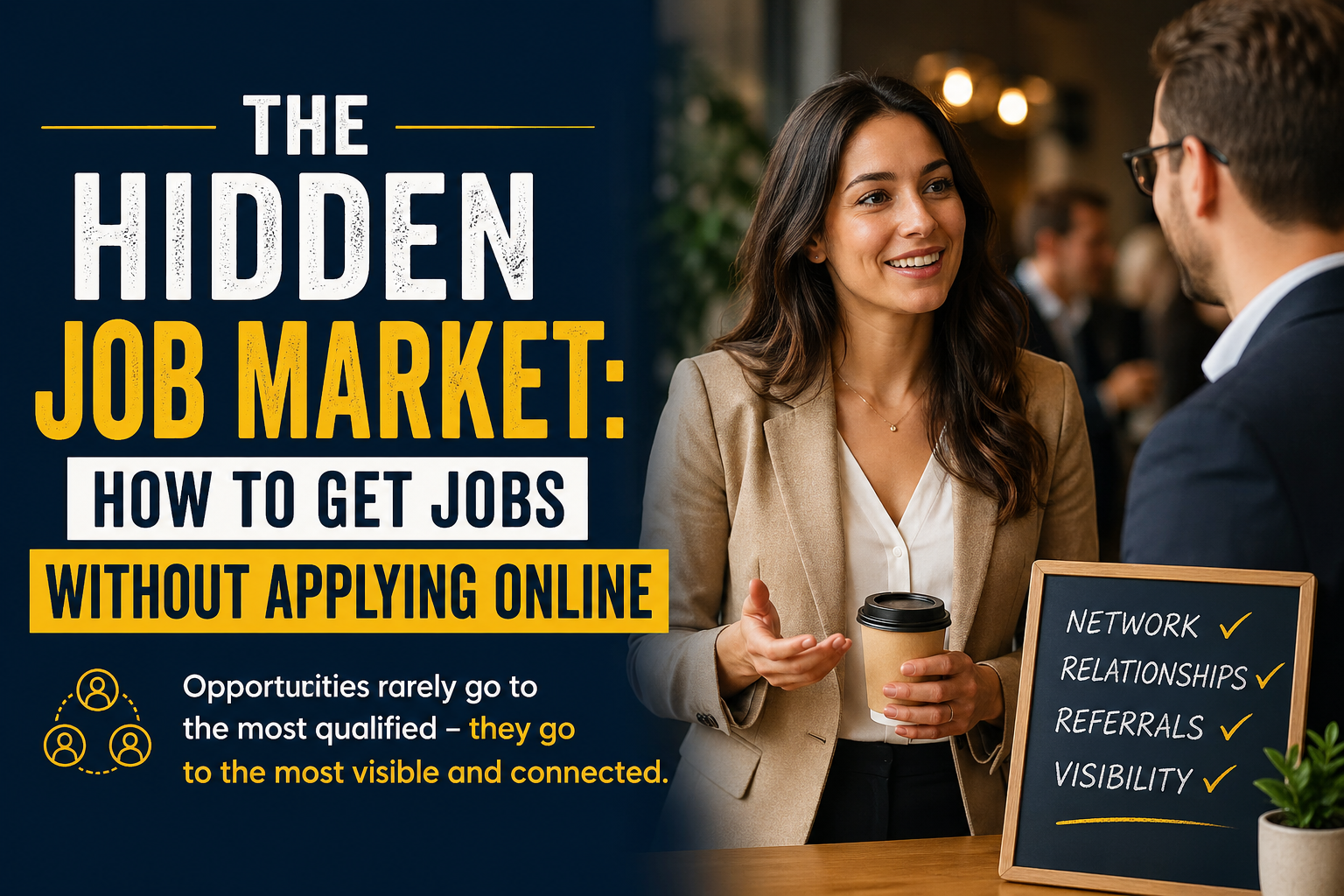
The Hidden Job Market: How to Get Jobs Without Applying Online

What if the job you’ve been searching for was never posted online in the first place?
Studies consistently show that a large percentage of job opportunities exist within the hidden job market—roles filled through referrals, internal hiring, or direct outreach rather than public job boards. Yet, most job seekers spend their time submitting applications into crowded portals, hoping to stand out among hundreds or even thousands of candidates.
If you’ve been applying online without results, the problem may not be your qualifications—it may be your strategy.
In this article, you’ll learn how the hidden job market works and, more importantly, how to access it using practical, proven techniques that can help you get jobs without applying online.
What is the Hidden Job Market?
The hidden job market refers to job opportunities that are not publicly advertised on job boards, company websites, or recruitment platforms.
These roles are typically filled through:
- Internal promotions or transfers
- Employee referrals
- Direct recommendations
- Recruiter networks
- Proactive hiring decisions
Why Many Jobs Are Never Advertised
Employers often avoid posting jobs publicly because:
- Cost efficiency: Advertising and screening candidates takes time and money
- Speed: Hiring through referrals is faster
- Trust: Referred candidates are often seen as lower risk
- Talent pipeline: Many companies already have a pool of pre-qualified candidates
In Nigeria and across Africa, this is even more pronounced.
Many businesses rely heavily on personal networks and recommendations when hiring.
Why Most Job Seekers Fail Online
If online applications were the only way to get hired, job searching would be straightforward—but it’s not.
Here’s why most people struggle:
1. Overwhelming Competition
A single job posting can attract hundreds or thousands of applicants. Your CV is competing in a saturated pool.
2. ATS (Applicant Tracking Systems)
Many companies use automated systems to filter CVs. If your CV doesn’t match specific keywords, it may never be seen by a human.
3. Generic Applications
Most job seekers send the same CV everywhere, reducing their chances of standing out.
4. Passive Approach
Submitting applications is reactive and passive. The hidden job market rewards proactive candidates.
7 Proven Ways to Access the Hidden Job Market
To succeed, you need a smarter job search strategy—one that positions you where opportunities exist before they’re advertised.
1. Strategic Networking
Networking is the most powerful way to access job opportunities without applying online.
Action Steps:
- Reach out to people in your industry (friends, alumni, professionals)
- Attend professional gatherings or webinars
- Join WhatsApp, Telegram, or Slack communities in your field
- Follow up consistently—not just when you need help
Key Insight: People hire people they know, trust, or are recommended by someone they trust.
2. Leveraging LinkedIn Effectively
LinkedIn is more than a digital CV—it’s a visibility tool.
Action Steps:
- Optimize your headline (not just “Job Seeker”)
- Share insights, lessons, or industry opinions weekly
- Engage with posts from recruiters and companies
- Send personalized connection requests
Example: Instead of “I need a job,” post:
“Here are 3 things I learned from managing a small business that apply to customer service roles.”
3. Informational Interviews
This is one of the most underused strategies in accessing the hidden job market.
An informational interview is a conversation where you learn about a role or company but not directly ask for a job.
Action Steps:
- Identify professionals in roles you admire
- Request a 10–15 minute conversation
- Ask about their career path, challenges, and advice
- End by asking: “Is there anyone else you recommend I speak with?”
Why it works: It builds relationships that often lead to opportunities.
4. Direct Outreach to Companies
Instead of waiting for job postings, approach companies proactively.
Action Steps:
- Identify companies you’d like to work for
- Research their needs and challenges
- Send a tailored email or message offering value
Example Approach:
- Introduce yourself briefly
- Highlight a relevant skill or experience
- Suggest how you can contribute
This method is particularly effective with startups and SMEs in Nigeria, where roles are often created around capable individuals.
5. Building a Personal Brand
Your visibility can attract opportunities—even when you’re not actively searching.
Action Steps:
- Share your work online (projects, case studies, insights)
- Create content around your field
- Showcase your skills through practical examples
Examples:
- A graphic designer posting design samples
- A marketer sharing campaign ideas
- A developer showcasing GitHub projects
Result: Employers come to you instead of the other way around.
6. Using Referrals and Insider Connections
Referrals significantly increase your chances of getting hired.
Action Steps:
- Let your network know you’re open to opportunities
- Be specific about the roles you want
- Ask for introductions, not just job leads
Example:
Instead of saying, “Please help me find a job,” say:
“I’m exploring customer service roles in fintech companies—do you know anyone I can speak with?”
7. Attending Industry Events & Communities
Opportunities often exist where professionals gather.
Action Steps:
- Attend career fairs, workshops, and seminars
- Join professional associations
- Participate actively in discussions
In Nigeria, many job opportunities are shared informally at events before they are ever announced publicly.
Real-Life Example: Getting a Job Without Applying Online
Consider Tunde, a fresh graduate in Lagos struggling to secure a role in digital marketing.
After months of unsuccessful applications, he changed his approach:
- He started engaging with marketing professionals on LinkedIn
- He attended a local digital marketing meetup
- He requested informational interviews with two professionals
During one conversation, a professional mentioned their company needed someone to assist with social media management—no job posting yet.
Tunde was introduced to the hiring manager, had a conversation, and got the role.
He never applied online.
Common Mistakes to Avoid
Even with the right strategy, certain mistakes can hold you back.
1. Waiting for Job Postings
If your entire strategy depends on job boards, you’re missing most opportunities.
2. Poor Networking Approach
Networking is not begging—it’s building genuine relationships.
3. Lack of Clarity
If you don’t know what role you want, others can’t help you effectively.
4. Weak Online Presence
Recruiters often check your online profile. An incomplete or inactive profile can reduce credibility.
5. Not Following Up
Many opportunities are lost due to lack of consistent follow-up.
In conclusion,
The reality is simple: the most effective way to get jobs today is not by applying online—it’s by positioning yourself within the hidden job market.
You don’t need years of experience to make this work. What you need is:
- A proactive mindset
- A clear strategy
- Consistent action
Start small:
- Reach out to one professional today
- Improve your LinkedIn profile
- Join one relevant community
Opportunities rarely go to the most qualified—they go to the most visible and connected.
If you’re serious about advancing your career, stop waiting for job postings. Start creating opportunities.
Over to You
Let’s make this interactive.
What insight did you gain from this post? Share your thoughts in the comments—someone else might learn from you too.