The First Five-Year Rule: The Dos and Don’ts

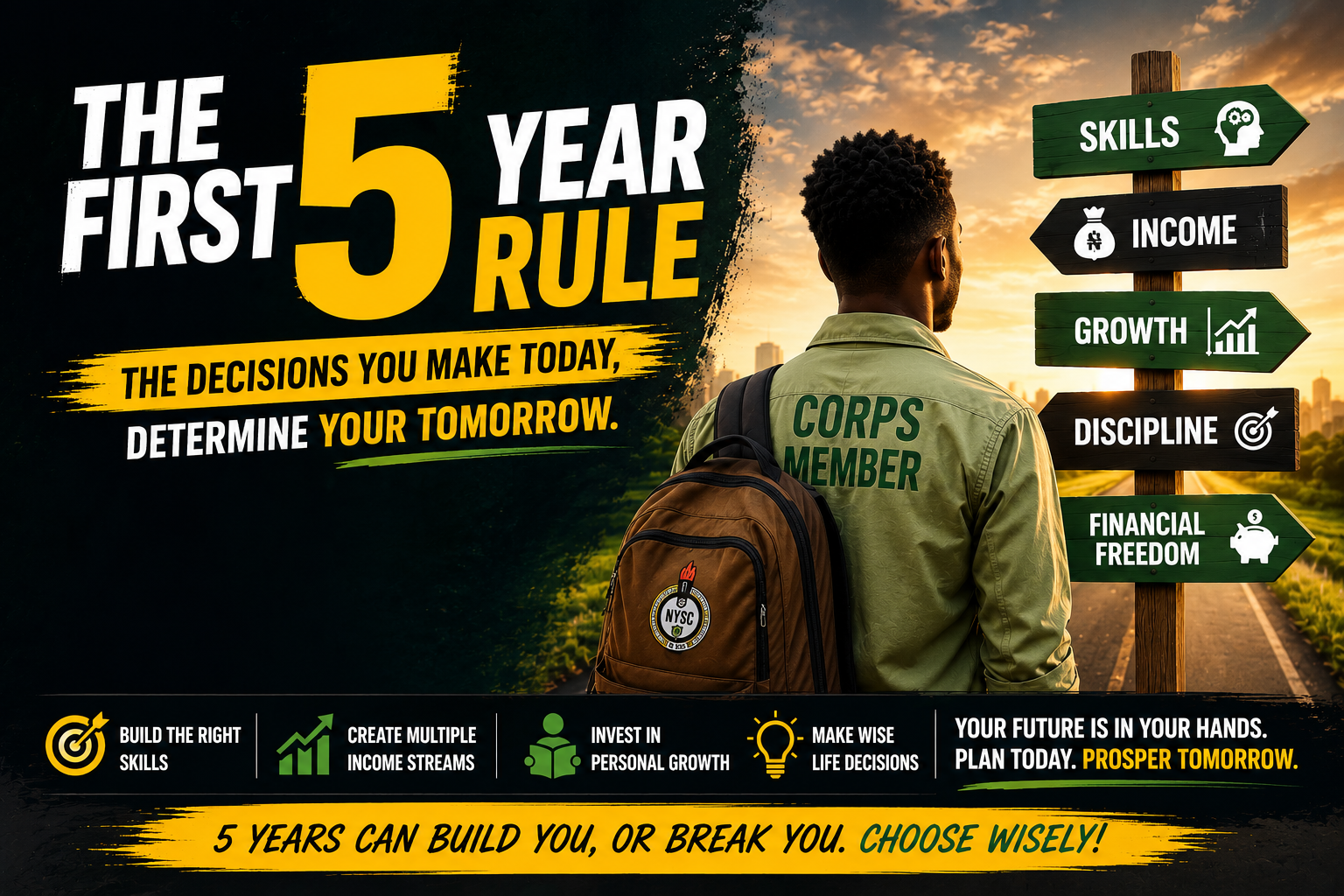
For many young Nigerians, completing the National Youth Service Corps (NYSC) program feels like crossing the finish line. But in reality, it is only the beginning. The period immediately after service is one of the most defining seasons of life. I call it “The First Five-Year Rule.”
These first five years after service are crucial because they shape your mindset, career direction, financial habits, relationships, and future opportunities. The decisions made during this period can either build a strong foundation for lifelong success or create struggles that may take decades to correct.
Many people underestimate this season because they are focused only on immediate survival. Yet, what you do between ages 22–30 often determines your future stability, relevance, confidence, and influence.
In this article, let’s discuss the important Dos and Don’ts that should guide you during these foundational years.
Why the First Five Years Matter So Much
The first five years after NYSC are important because this is the period where:
- Your habits become permanent.
- Your professional identity begins to form.
- Your network expands or shrinks.
- Your earning capacity is shaped.
- Your mindset toward money and growth develops.
- Your life decisions start producing long-term consequences.
During this season, many people make emotional decisions because of pressure from family, society, friends, or social media comparisons. Unfortunately, wrong priorities during this period can delay progress for many years.
The good news is that with intentionality, discipline, and strategic thinking, these years can become the launching pad for an extraordinary future.
THE DOS
1. Identify Gaps and Lapses
One of the greatest mistakes young graduates make is assuming that having a degree automatically guarantees success. School gives academic knowledge, but the real world exposes many missing pieces.
This is why you must identify both your gaps and lapses.
What Is a Gap?
A gap is something important you do not yet know or possess.
Examples include:
- Lack of communication skills
- Poor digital skills
- No leadership skill
- Weak financial knowledge
- Inability to use modern workplace tools
Gaps are missing competencies.
What Is a Lapse?
A lapse is a weakness in behavior, attitude, discipline, or consistency.
Examples include:
- Procrastination
- Poor time management
- Laziness
- Lack of professionalism
- Emotional instability
- Inconsistency
Lapses are behavioral deficiencies.
Why This Matters
Many graduates focus only on certificates while ignoring character and competence deficiencies. Success in life is built on both skill and discipline.
Questions to Ask Yourself
- What skills do employers currently demand that I lack?
- What personal habits are slowing my growth?
- What areas of my life need urgent improvement?
- What feedback do people consistently give me?
Self-awareness is the beginning of transformation.
2. Close the Gaps and Lapses
Identifying weaknesses is useless if nothing is done about them. The next step is deliberate improvement.
Personal development must become a lifestyle, not a one-time event.
How to Close Skill Gaps
- Take online courses
- Attend workshops and seminars
- Volunteer for projects
- Learn from mentors
- Read books consistently
- Practice what you learn
How to Correct Lapses
- Build routines
- Create accountability systems
- Set measurable goals
- Improve your environment
- Avoid toxic influences
- Develop discipline gradually
Important Truth
The real-world rewards value, not excuses. Your beautiful and genuine excuses will not give you the quality of life you desire, your competence and discipline will.
The faster you improve yourself, the faster opportunities begin to locate you.
3. Create Income Skills and Multiple Income Streams
One source of income is becoming increasingly insufficient in today’s economy. Young people must intentionally build income-generating skills.
An income skill is any skill that can solve problems and generate money consistently.
Examples of Income Skills
- Digital marketing
- Graphic design
- Web development
- Video editing
- Content creation
- Copywriting
- Public speaking
- Social media management
- Data analysis
- Photography
- Project management
Why Income Skills Matter
Income skills:
- Increase employability
- Reduce dependence
- Create financial confidence
- Open entrepreneurial opportunities
- Provide economic security
Multiple Income Streams
Do not depend entirely on one source of income. Learn how to create side opportunities.
Examples include:
- Freelancing
- Consulting
- Teaching
- Affiliate marketing
- Online business
- Selling digital products
- Coaching or training
Financial stability rarely comes from a single stream alone.
4. Expand Your Job Streams
Your degree should not become a prison.
Many graduates limit themselves only to jobs directly connected to their courses of study. In today’s world, adaptability is a major advantage.
For example:
- A Mass Communication graduate can work in customer service, digital marketing, public relations, administration, media consulting, sales, or project coordination.
- An Engineering graduate can move into operations management, data analytics, technical sales, or product management.
- A Sociology graduate can thrive in HR, administration, community development, customer experience, or training.
How to Expand Job Streams
You can widen your opportunities through:
- Professional certifications
- Corporate trainings
- Soft skill development
- Digital skills acquisition
- Networking
- Internships and volunteering
Valuable Professional Areas
Consider learning:
- Customer service
- Human resource management
- Project management
- Business analysis
- Digital marketing
- Sales and negotiation
- Communication and presentation skills
- Operations Management
- Procurement
- Risk Management
- Health, Safety & Environment (HSE)
- Product Development and Management
The wider your competence, the wider your opportunities.
5. Invest in Personal Growth
One of the best investments you can make in your twenties is investing in yourself.
Personal growth affects:
- Confidence
- Communication
- Leadership
- Emotional intelligence
- Decision-making
- Professional relevance
Ways to Invest in Yourself
- Read consistently
- Attend conferences
- Build healthy relationships
- Learn from successful people
- Improve your communication
- Develop emotional intelligence
- Build leadership capacity
Remember This
Your income eventually aligns with your value.
If you stop growing, you start becoming irrelevant.
THE DON’TS
1. Do Not Delay Skill Acquisition
Time is extremely valuable after NYSC. The earlier you begin learning valuable skills, the better your future positioning.
Many graduates waste years waiting for “perfect opportunities” instead of preparing themselves.
The Danger of Delay
When you delay learning:
- Others become more competitive
- Opportunities pass by
- Confidence reduces
- Dependence increases
Start Small
You do not need to know everything immediately. Start with one relevant skill and grow from there.
Your future rewards will often reflect how early you started preparing.
2. Avoid Survival-Centered Effort
Survival is important, but it must not become your only focus.
Many people become trapped in cycles of daily struggle without building long-term capacity.
What Survival-Centered Living Looks Like
- Taking any job without growth potential
- Ignoring learning opportunities
- Working only to solve immediate needs
- Refusing to invest in self-development
- Living without long-term planning
A Better Approach
While surviving, also:
- Learn
- Build
- Save
- Network
- Grow
- Strategize
Temporary hardship should not stop long-term vision.
3. Avoid Premature Marriage
Marriage is a beautiful institution, but timing matters.
One of the biggest mistakes young people make is entering marriage before achieving emotional, financial, and mental stability.
Why Premature Marriage Can Be Dangerous
It can:
- Increase financial pressure
- Slow personal development
- Create emotional frustration
- Limit opportunities for growth
- Lead to avoidable conflicts
Questions to Consider Before Marriage
- Am I emotionally mature?
- Do I have financial stability?
- Am I still discovering myself?
- Can I handle responsibility effectively?
Marriage should complement you and not build you. So, build yourself first before getting married.
4. Avoid Premature Black Tax Responsibility
Black tax refers to the financial burden placed on people by family members and relatives who feel entitled to financial assistance because of family or close ties.
Helping one’s family is a honorable thing to do, but overburdening yourself too early and especially within the first five years after service can damage your future.
The Problem
Many young people:
- Neglect savings
- Ignore investments
- Abandon personal growth
- Accumulate debt
- Live under constant pressure
All because they are trying to solve everybody’s problems.
A Balanced Approach
Support family wisely while also:
- Building your future
- Creating financial structure
- Saving consistently
- Investing in yourself
You cannot sustainably help others if you destroy yourself in the process.
The best favor you can do your family and community is to ensure that you’ve a thriving, noble career and financial stability.
5. Avoid Financial Rascality
One of the fastest ways to waste your first five years is careless financial behavior.
Financial rascality includes:
- Excessive spending
- Unnecessary lifestyle competition
- Impulse buying
- Party addiction
- Living above your income
- Borrowing to impress people
The Social Media Trap
Many young people are under pressure to “look successful” online while being financially unstable offline.
Avoid comparing your journey to edited lifestyles on social media.
Build Financial Discipline Early
Learn to:
- Budget
- Save
- Invest
- Delay gratification
- Track expenses
- Build emergency funds
Financial discipline in your twenties creates freedom in your thirties and beyond.
Finally,
Your first five years after NYSC are not just another phase of life. They are your foundation years.
This season is where:
- habits are formed,
- direction is chosen,
- opportunities are created,
- and destiny is shaped.
Do not waste these years trying to impress people or rushing into unnecessary pressure. Use them to build competence, character, financial stability, and clarity.
The truth is:
Genuine excuses don’t deliver results, competence and discipline does.
Your future is decided by:
- the skills you build,
- the discipline you develop,
- the decisions you make,
- and the value you consistently create.
Take these first five years seriously, and your future self will thank you for it.
Now, Over to you,
What part of “The First Five-Year Rule” resonates with you the most?
Share your thoughts, lessons, or personal experiences in the comment section.
Your story may encourage another young graduate preparing for life after service.
Also, if you found this article valuable, kindly share it with fellow Corps Members, & friends.