

Status Without Status: The Decadence of Modern Society

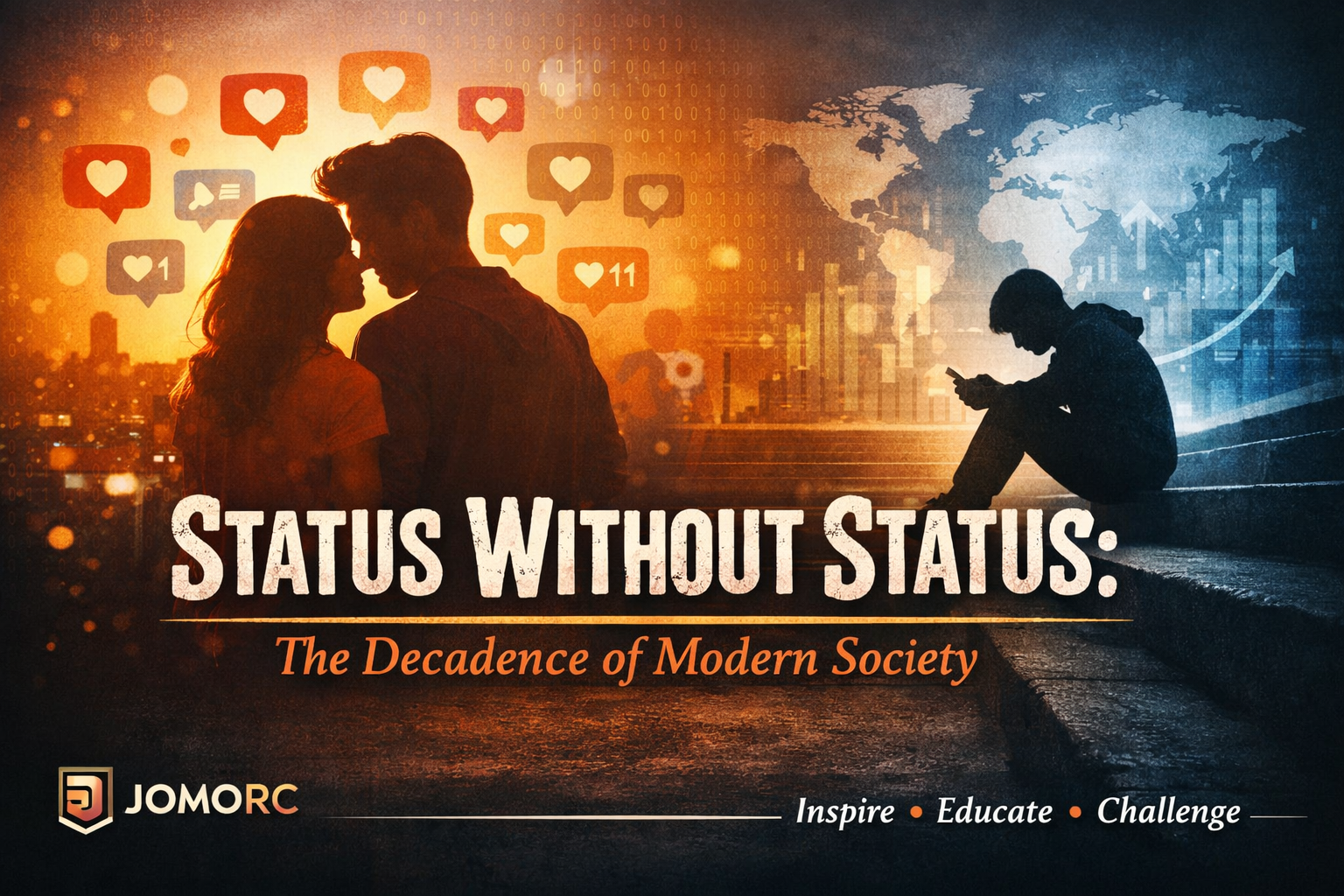
There is a growing and deeply concerning trend among teenagers and young adults today—an overwhelming obsession with romantic relationships at the expense of personal growth.
What makes this issue particularly dangerous is that it is subtle, normalized, and largely ignored.
In a world driven by social media, the meaning of “status” has shifted. For many young people, relationship status now carries more weight than educational, financial, or personal development status.
This is what I describe as “status without status”—a misplaced priority system that is quietly shaping a generation.
Social Media and the Distortion of Sexual Awareness
Before the rise of the internet and social platforms, there was a legitimate concern about poor sexual education. Parents, schools, and institutions were encouraged to do more.
Today, that gap has been filled—but in a dangerously unstructured way.
Social media has:
- Increased access to sexual content
- Blurred the line between education and exposure
- Normalized early romantic and sexual involvement
The result?
A generation that is overexposed but under-guided.
The critical question becomes:
Where is the boundary between proper sexual education and premature romantic stimulation?
Right now, that boundary is almost non-existent.
The Shift in Priorities: Romance Over Responsibility
One of the most alarming realities today is this:
Many teenagers are more deliberate about changing their relationship status than improving their life status.
Instead of focusing on:
- Skill acquisition
- Education
- Character development
- Career direction
There is an increasing fixation on:
- Dating
- Sexual experiences
- Physical attractiveness
- Social validation
It is no longer unusual to find teenagers with multiple relationship histories before adulthood.
This represents a fundamental shift in societal values.
Then vs Now: A Cultural Contrast
Reflecting on the past provides useful context.
Years ago, there was a shared societal understanding:
- Certain behaviors were age-inappropriate
- The community played a role in correcting misconduct
- Parents, teachers, and adults actively enforced moral boundaries
Today, that system has weakened significantly.
We now live in a society where:
- Correcting a child can be seen as interference
- Teachers are restricted to academic roles (“teach and go”)
- Community-based parenting has nearly disappeared
The consequence is a generation growing up with less guidance and fewer boundaries.
The Collapse of Moral and Institutional Support Systems
The issue goes beyond individual behavior—it reflects systemic failure.
1. Weakening Parenting Structures
Many parents today are:
- Overwhelmed
- Underprepared
- Disconnected from their children’s realities
Some lack a clear understanding of the purpose and responsibility of parenting.
2. Erosion of School Discipline
Schools, once centers of character formation, are now largely limited to academic instruction.
Reports from educators reveal troubling patterns:
- Students consuming explicit content even within school environments
- Reduced authority of teachers to enforce discipline
- A growing disconnect between learning and behavior
3. Peer and Media Influence
Teenagers are now being shaped more by:
- Social media trends
- Influencer culture
- Peer validation systems
Rather than:
- Family values
- Educational frameworks
- Community standards
The Rise of “Physical Assets” Over Real Value
Another disturbing trend is the growing belief among young people—especially teenage girls—that physical appearance is their most valuable asset.
There is increasing focus on:
- Body enhancement
- Sexual appeal
- Attractiveness as currency
This is reinforced by:
- Online trends
- Influencer culture
- Societal validation of appearance over substance
Meanwhile, critical areas such as:
- Education
- Skills development
- Intellectual growth
Are often neglected.
This creates a dangerous imbalance.
A Generation at Risk of Missing the Digital Economy
Ironically, this shift is happening at a time of unprecedented opportunity.
We are in the age of the digital economy, where young people have access to:
- Remote work opportunities
- Digital skills
- Global markets
- Content creation platforms
Teenagers and young adults should be:
- Building skills
- Exploring technology
- Creating value
Instead, many are becoming passive consumers, driven by short-term gratification rather than long-term growth.
The Core Problem: Misplaced Identity and Value Systems
At its core, this issue is about identity.
When a young person defines their worth primarily by:
- Who they are dating
- How attractive they appear
- How much attention they receive
They lose sight of:
- Who they are becoming
- What they are building
- Where they are going
This is the essence of status without status.
The Way Forward: Rebuilding Structure and Awareness
Addressing this issue requires intentional action across multiple levels:
1. Parents Must Re-engage
- Understand modern challenges
- Provide guidance, not just provision
- Rebuild value systems at home
2. Schools Must Reclaim Character Development
- Go beyond academics
- Reinforce discipline and values
- Partner with parents
3. Society Must Normalize Correction Again
- Responsible intervention should not be seen as interference
- Community-based moral support must be revived
4. Young People Must Be Redirected
- Toward skills and personal development
- Toward purpose-driven living
- Toward long-term thinking
A Call for Urgent Attention
This is not just a youth issue—it is a societal issue.
We are raising a generation that risks:
- Prioritizing pleasure over purpose
- Choosing validation over value
- Pursuing status that has no substance
If left unchecked, the long-term consequences will affect:
- The workforce
- The economy
- The moral fabric of society
It is time to confront this reality directly.
Because a generation focused on romance over responsibility is a generation at risk of losing its future.
Over to You
Found this inspiring? I’d love to hear from you.
What’s one thing you learned from this post? Share it in the comments below.