

JomoRC Lead Consultant Shares Practical Strategies for Maximising Generative AI at Kogi Youth in Tech Training

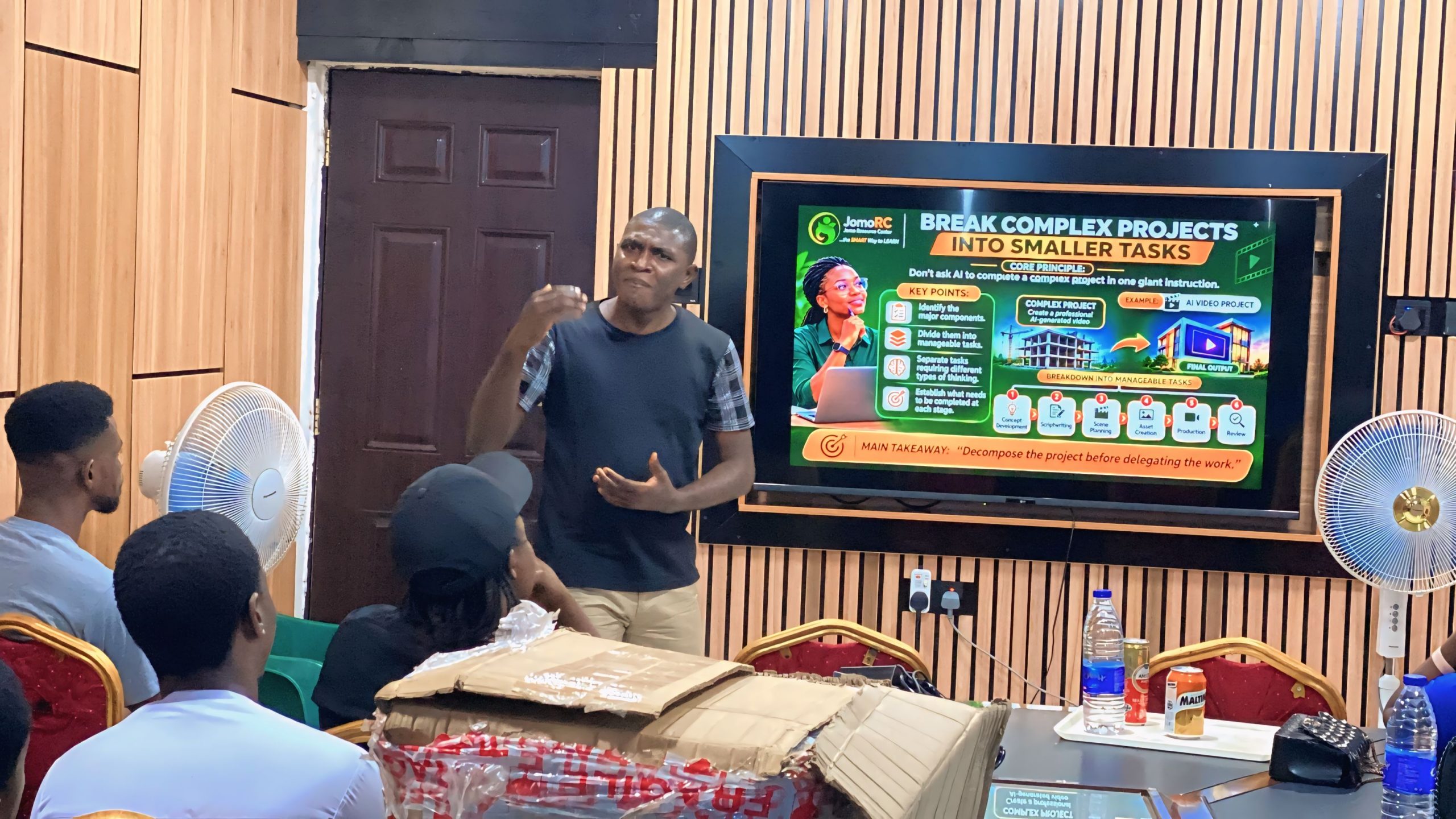
Mr. Gabriel Simon Ejeh challenges tech experts to remain creators in the age of AI, emphasising that artificial intelligence should amplify human creativity rather than replace it.
Jomo Resource Center (JomoRC) has further demonstrated its commitment to youth digital capacity development through the participation of its Lead Consultant, Mr. Gabriel Simon Ejeh, as a guest speaker at the Kogi Youth in Tech Training Programme held on Sunday, 1 November 2026, at the Millennium Builder’s Plaza, Central Business District, Abuja.
Mr. Ejeh was formally invited by the Programme Coordinator, Mr. Anthony Alidu, to deliver a session titled “Generative AI: Tips & Hacks for Maximizing Tool Capabilities.”
The programme, sponsored by MTN Nigeria and the Igala Diaspora Association, brought together a mix of aspiring technology professionals and practising tech experts seeking to strengthen their knowledge and capabilities in the rapidly evolving digital landscape.
Moving Beyond Basic AI Usage
During his presentation, Mr. Ejeh challenged participants to look beyond the excitement surrounding generative AI tools and develop a more intentional approach to using them.
He emphasised that access to powerful AI tools does not automatically translate into useful results. Rather, the quality of outcomes depends significantly on how users define their objectives, communicate instructions, provide context and manage their interactions with AI systems.
He highlighted seven important principles for maximising generative AI capabilities:
- AI capability does not automatically translate into useful results: Having access to advanced AI tools is not enough; users must understand how to direct them effectively.
- Define the outcome before asking AI to produce anything: Clearly establish the intended result before beginning an AI interaction.
- Break complex projects into smaller tasks: Approach complicated assignments systematically instead of expecting AI to deliver everything in one attempt.
- Work in the right sequence and provide the right context: Give AI the background information and instructions necessary to produce relevant outputs.
- Give AI a clear assignment: Communicate expectations, responsibilities and desired deliverables precisely.
- Treat AI conversations as an ongoing workflow: Build on previous interactions rather than treating every prompt as an isolated request.
- Give feedback that AI can act on: Refine outputs through specific, constructive feedback that guides the system towards the desired result.
These principles formed the foundation of his presentation, which was supported by instructional slides and focused on helping participants develop a more structured and productive approach to generative AI.
Human Creativity Must Remain at the Centre
One of the central messages of the presentation was the importance of preserving human creativity, originality and professional identity in an era increasingly influenced by generative AI.
Mr. Ejeh cautioned tech experts against becoming overly dependent on AI-generated alternatives at the expense of their own creative abilities and professional ingenuity.
He stated:
“Tech experts in the era of AI must ensure to compel and engage AI tools to produce their own creativity, design, concept, feel and tone rather than relying on Generative alternatives. Experts must remain the creators while AI assists them in creating their results and impact.”
He reinforced the need for technology professionals to approach AI as an enabling tool that supports their ideas, improves their processes and expands their capacity to deliver results, rather than as a replacement for their expertise.
This perspective highlights an important distinction in the evolving relationship between humans and artificial intelligence: the objective should not be to surrender creative responsibility to AI, but to use AI to strengthen the quality, efficiency and impact of human-led work.
Positive Reception from Participants
The presentation was well received by participants, who expressed enthusiasm and appreciation for the insights shared. The session provided an opportunity for aspiring and practising technology professionals to reconsider how they approach AI tools and how they can integrate them more intentionally into their work.
The Programme Coordinator, Mr. Anthony Alidu, expressed appreciation for the depth of knowledge and insights delivered during the session and encouraged participants to continue building on what they had learned.
JomoRC’s Commitment to Digital Capacity Development
Jomo Resource Center remains committed to promoting practical digital knowledge, technology adoption and capacity development through training, workshops, institutional engagements and strategic learning initiatives.
Through engagements such as the Kogi Youth in Tech Training Programme, JomoRC continues to contribute to conversations and learning opportunities that help young people and professionals navigate emerging technologies and prepare for evolving opportunities in the digital economy.
As generative AI continues to reshape the technology landscape, JomoRC believes that the future belongs not simply to those who use AI, but to those who understand how to direct it, challenge it and leverage its capabilities to create meaningful value.
The message is simple: AI should assist human creativity, not replace it.
Jomo Resource Center — …the SMART Way to LEARN.


